Sinus node dysfunction causing inappropriate bradycardia, sinus pauses, or alternating tachy-brady patterns — leading indication for permanent pacing.
Also known as: sick sinus syndrome, SSS, sinus node dysfunction, tachy-brady syndrome, SND
Overview
Heterogeneous syndrome of sinus node dysfunction producing symptomatic inappropriate sinus bradycardia, sinus pauses or arrest, chronotropic incompetence (failure to increase heart rate appropriately with exertion), sinoatrial exit block, or alternating periods of bradycardia and supraventricular tachyarrhythmias (most often atrial fibrillation) — the latter pattern is termed 'tachy-brady syndrome.'
Epidemiology
Most common indication for permanent pacemaker implantation in the United States. Incidence rises sharply with age; primarily a disease of older adults (median age at diagnosis ~70). Approximately 1 case per 600 cardiac patients age >65. Lifetime risk of new AFib in patients with SSS is high.
Try two board-style Sick Sinus Syndrome questions
Real questions from the FirstPassPA bank, with the full explanation. Pick an answer — no signup, no email.
Question 1CardiovascularMedium
A 76-year-old woman has newly diagnosed sick sinus syndrome of the tachy-brady variant, with paroxysmal atrial fibrillation alternating with sinus pauses. Her CHA2DS2-VASc score is 3. She is being counseled about long-term risks before pacemaker placement. Which of the following complications is she most likely to develop without appropriate therapy?
ASudden cardiac death
BComplete heart block
CDilated cardiomyopathy
DThromboembolic stroke
Reveal answer & full explanation
Correct answer: D — Thromboembolic stroke
ASudden cardiac death
BComplete heart block
CDilated cardiomyopathy
DThromboembolic stroke✓
Why thromboembolic stroke is correct
In tachy-brady sick sinus syndrome, the paroxysmal atrial fibrillation drives left atrial appendage stasis and thrombus formation, making systemic thromboembolism the dominant long-term risk.
Her CHA2DS2-VASc score of 3 places her at meaningful annual stroke risk, and current guidance directs long-term oral anticoagulation based on that score, independent of pacemaker placement.
The pacemaker corrects the bradycardia and permits rate-controlling drugs but does nothing to lower embolic risk, so without anticoagulation stroke is the complication she is most likely to suffer.
Why the others are wrong
Sudden cardiac death — sick sinus syndrome is a disorder of impulse formation, not reentrant ventricular arrhythmia, so VF-related sudden death is uncommon (anchoring on 'arrhythmia equals sudden death').
Complete heart block — conduction-system disease can coexist and progress, but it is less frequent than stroke and is already addressed by the planned pacemaker (right-organ-wrong-risk).
Dilated cardiomyopathy — bradycardia-related cardiomyopathy is rare and largely reversible with pacing; tachycardia-mediated cardiomyopathy from uncontrolled AF is more plausible but still less common than thromboembolism (premature closure on the bradycardia).
Question 2CardiovascularEasy
A 78-year-old woman reports several months of intermittent lightheadedness, fatigue, and one episode of near-syncope while gardening. She takes no rate-controlling medications. On exam, HR is 42/min and regular, BP 134/82 mm Hg. An office ECG shows sinus bradycardia at 40/min with a 2.4-second sinus pause. Ambulatory monitoring captures alternating periods of sinus bradycardia and bursts of atrial fibrillation with rapid ventricular response, correlating with her symptoms. What is the most likely diagnosis?
AVasovagal (neurocardiogenic) syncope
BCarotid sinus hypersensitivity
CSick sinus syndrome (tachy-brady)
DMobitz type II second-degree AV block
Reveal answer & full explanation
Correct answer: C — Sick sinus syndrome (tachy-brady)
AVasovagal (neurocardiogenic) syncope
BCarotid sinus hypersensitivity
CSick sinus syndrome (tachy-brady)✓
DMobitz type II second-degree AV block
Why Sick sinus syndrome (tachy-brady) is correct
Sick sinus syndrome (SSS), also called sinus node dysfunction, is intrinsic degeneration of the sinoatrial node, most common in older adults
The tachy-brady variant features alternating sinus bradycardia or pauses with paroxysmal supraventricular tachyarrhythmias, most often atrial fibrillation
Produces symptoms of cerebral hypoperfusion: fatigue, lightheadedness, and syncope
Documentation of symptom-rhythm correlation on ambulatory monitoring confirms the diagnosis
Why the others are wrong
A) Vasovagal (neurocardiogenic) syncope — reflex syncope is provoked by upright posture, heat, or pain and the heart rate is normal between episodes; it does not explain months of resting bradycardia at 40/min, a 2.4-second sinus pause, or bursts of atrial fibrillation
D) Mobitz type II second-degree AV block — a disease of the His-Purkinje system with non-conducted P waves and unchanging PR intervals; this patient's problem is sinus node automaticity, not AV conduction
B) Carotid sinus hypersensitivity — causes syncope triggered by neck pressure or head turning with reproducible pauses on carotid massage, not spontaneous tachy-brady alternation
🔒 Free preview limit reached
Keep reading — start your free trial
You've read your 2 free diagnosis previews. Create your free account to unlock the full Sick Sinus Syndrome outline — plus all 514 diagnoses, 6,500+ board-style questions, flashcards, and an AI tutor. Your 7-day free trial includes everything, and there's no credit card required.
Inferior MI involving the sinus node artery (right coronary in ~60%, left circumflex in ~40%)
Familial / genetic (SCN5A, HCN4 mutations)
Pathophysiology
Progressive degeneration and fibrosis of the sinus node and surrounding atrial myocardium impair automaticity and conduction from the SA node to the surrounding atrium. The result is inappropriate bradycardia and pauses. Atrial fibrosis simultaneously creates substrate for atrial arrhythmias, producing the tachy-brady pattern. After termination of tachyarrhythmias, prolonged sinus pauses (offset pauses) may produce symptoms.
Clinical presentation
Symptoms
Fatigue, lightheadedness, presyncope, syncope
Exertional dyspnea and exercise intolerance (chronotropic incompetence)
Palpitations from intermittent tachyarrhythmias (often AFib)
Cognitive slowing, confusion
Sometimes asymptomatic with incidental bradycardia or pauses on ECG
Signs / physical exam
Bradycardia or irregular pulse
May appear well between episodes
Findings of underlying heart disease if present
Classic findings
Older adult with intermittent syncope, exercise intolerance, and ambulatory ECG capturing alternating bradycardia, pauses, and atrial tachyarrhythmias — the tachy-brady pattern.
Differential diagnosis
Athletic heart / physiologic bradycardia — Resting HR may be 40s-50s in well-trained athletes but with appropriate chronotropic response to exertion; asymptomatic
Hypothyroidism — Other systemic features, elevated TSH
Obstructive sleep apnea — Nocturnal bradycardia with daytime sleepiness; polysomnography
AV block (especially second/third-degree) — PR prolongation/dissociation rather than slow sinus rate; pacing indication is similar in symptomatic forms
Vasovagal syncope / neurally mediated — Situational triggers, prodrome of warmth/nausea, normal Holter outside of episode
Carotid sinus hypersensitivity — Provoked by neck pressure or head turning; >3 sec asystole with carotid massage
Diagnostic workup
Diagnostic criteria
Diagnosis requires correlation of bradyarrhythmia or pauses with symptoms. Common ECG findings supporting SSS: persistent sinus bradycardia <50 bpm without identifiable reversible cause, sinus pauses ≥3 seconds, chronotropic incompetence on exercise testing, alternating bradycardia and atrial tachyarrhythmias.
Labs
BMP including potassium, magnesium, calcium
TSH
Digoxin or other relevant drug levels
Troponin if ACS suspected (especially with inferior wall ischemia)
Ambulatory monitoring — KEY diagnostic tool: 24-48 hour Holter, 30-day event monitor, 14-30 day patch monitor, or implantable loop recorder if symptoms are infrequent
Exercise stress testing for chronotropic incompetence (failure to achieve >80% of age-predicted max HR or HR <100 bpm during peak exercise)
Echocardiography to evaluate for structural heart disease
Electrophysiology study selectively used if diagnosis remains unclear
Diagnostic algorithm
ECG Pattern
Description
Implication
Inappropriate sinus bradycardia
Persistent HR <50 awake without reversible cause
Suggestive of SND
Sinus pause / arrest
Pause ≥3 seconds with absent P wave
Symptomatic pauses warrant pacing
Sinoatrial exit block
Multiple of P-P interval skipped
SND variant
Chronotropic incompetence
<80% predicted max HR on exercise
Pacing for symptomatic exercise intolerance
Tachy-brady pattern
AFib alternating with bradycardia or pauses
Pacemaker permits safe AV nodal blocker use
Junctional escape rhythm
Narrow QRS at 40-60 without preceding P
Compensatory rhythm in failed sinus node
ECG patterns characteristic of sick sinus syndrome.
Treatment
First-line
Discontinue offending medications if present (beta-blockers, CCBs, digoxin, amiodarone, ivabradine) and reassess
Correct underlying conditions: hypothyroidism, electrolyte abnormalities, OSA
Permanent pacemaker is the definitive therapy for symptomatic sick sinus syndrome — most often dual-chamber (DDD) pacing with mode-switching capability; single-chamber atrial pacing (AAI) is rarely used now given the risk of subsequent AV block. Class I indication: symptomatic SND with documented symptomatic bradycardia or pauses, or chronotropic incompetence
Asymptomatic sick sinus syndrome does NOT require pacing
Second-line / adjunct
Manage atrial tachyarrhythmias in tachy-brady syndrome: rate control becomes much safer after pacemaker placement, allowing use of beta-blockers, CCBs, or antiarrhythmic drugs that would otherwise exacerbate bradycardia
Anticoagulation for AFib per CHA2DS2-VASc score (direct oral anticoagulants for non-valvular AFib)
Catheter ablation of atrial fibrillation can sometimes improve sinus node function and reduce dependence on pacing
Theophylline or oral atropine analogs are rarely used as bridges in select cases
Complications
Syncope with injury
Atrial fibrillation and thromboembolic stroke
Heart failure from chronotropic incompetence and chronic AFib
Pacemaker complications (infection, lead displacement, pacemaker-mediated tachycardia)
Progressive conduction system disease (development of AV block over time)
PANCE pearls
Sick sinus syndrome is the most common indication for permanent pacemaker placement in the U.S.
Symptom-rhythm correlation is essential — bradycardia or pauses must be linked to symptoms before committing to pacemaker therapy. Ambulatory monitoring is the workhorse.
Beta-blockers, nondihydropyridine CCBs, digoxin, amiodarone, and ivabradine are common culprits — always review the medication list before diagnosing SSS.
Tachy-brady syndrome: pacemaker controls bradycardia and enables safe use of AV nodal blockers and antiarrhythmics for the tachy component.
Anticoagulation is required for AFib in SSS regardless of pacemaker placement — CHA2DS2-VASc guides therapy.
Images
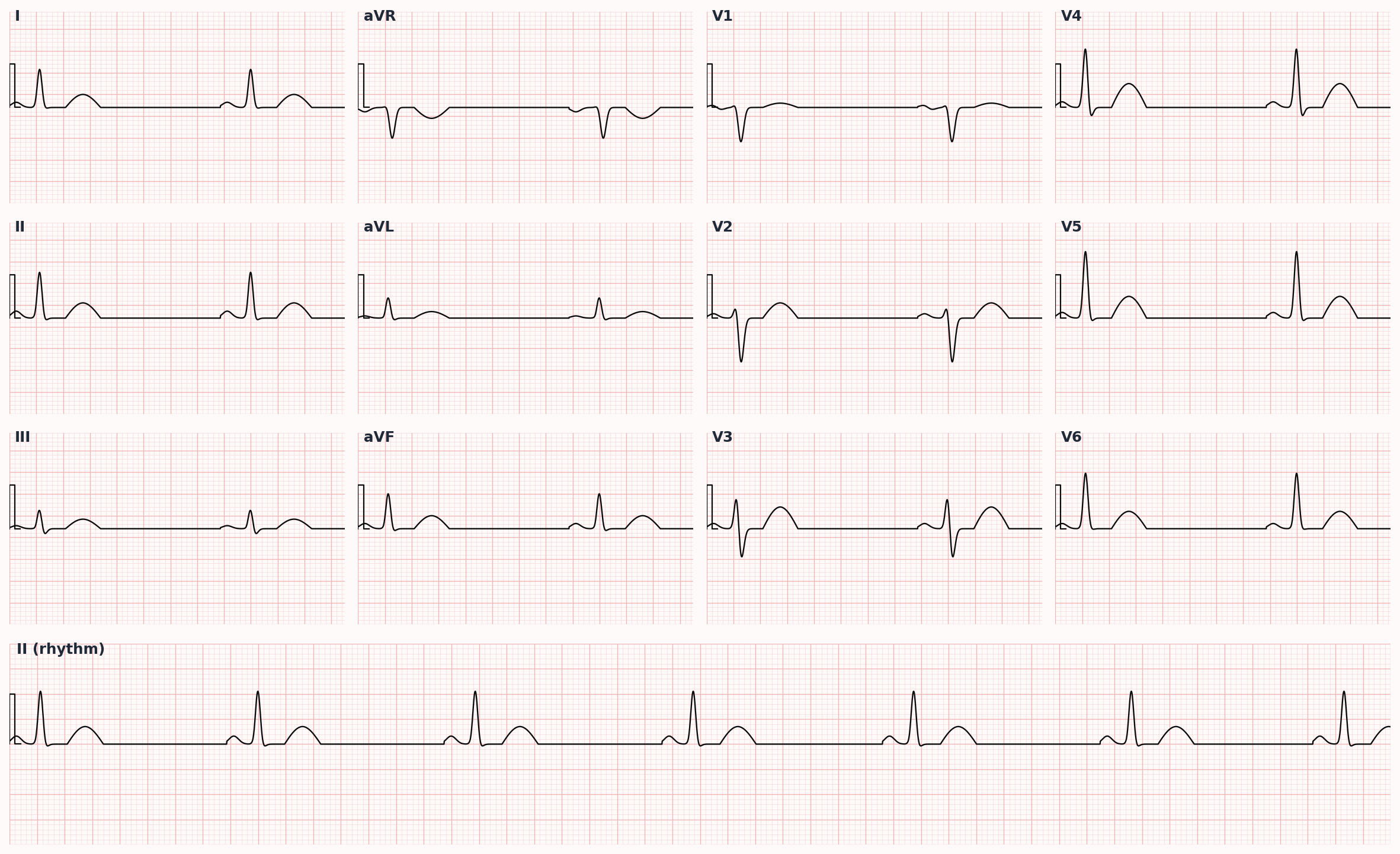
Sinus bradycardia — sinus rhythm at rate <60 bpm; persistent inappropriate bradycardia is a hallmark of SSS
References
ACC/AHA/HRS 2018 — 2018 ACC/AHA/HRS Guideline on the Evaluation and Management of Patients with Bradycardia and Cardiac Conduction Delay (Kusumoto et al., JACC 2019)
ESC 2021 — 2021 ESC Guidelines on Cardiac Pacing and Cardiac Resynchronization Therapy (Glikson et al., Eur Heart J 2021)
MOST Trial — Mode Selection Trial in Sinus-Node Dysfunction (Lamas et al., NEJM 2002)
Practice Cardiovascular questions on FirstPassPA
Turn this outline into retention. 6,500+ board-style questions with an AI tutor that explains every answer — free to start, no card required.
Educational use only. This outline is a study aid for PA students and is not medical advice or a substitute for clinical judgment. FirstPassPA is an independent study tool and is not affiliated with, endorsed by, or sponsored by NCCPA or PAEA. PANCE® and PANRE® are registered trademarks of the National Commission on Certification of Physician Assistants; End of Rotation™ is a program of the Physician Assistant Education Association.