Delay or failure of AV nodal or infranodal conduction — first-degree, Mobitz I/II, third-degree (complete).
Also known as: AV block, heart block, first-degree AV block, Mobitz I, Wenckebach, Mobitz II, third-degree heart block, complete heart block
Overview
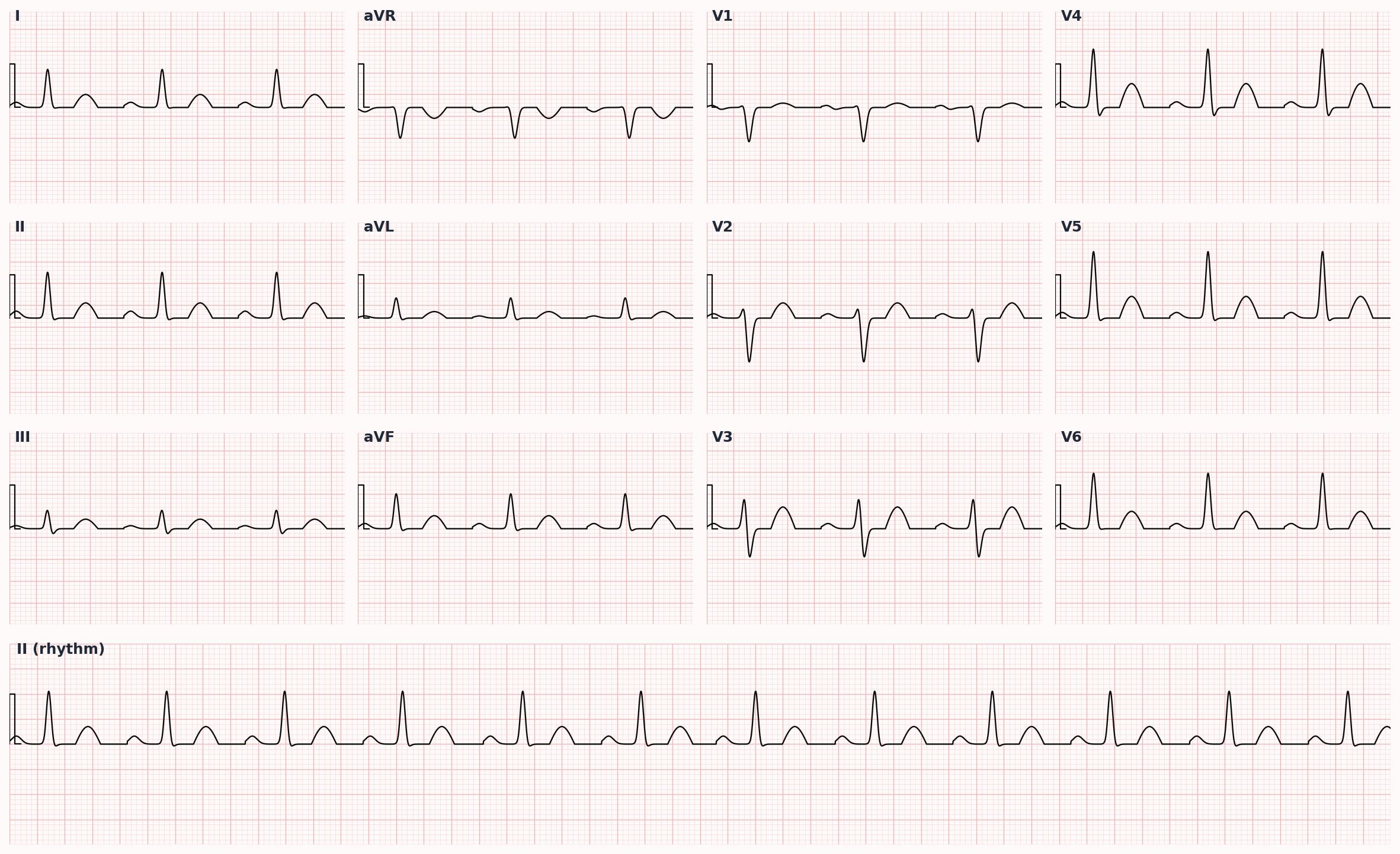
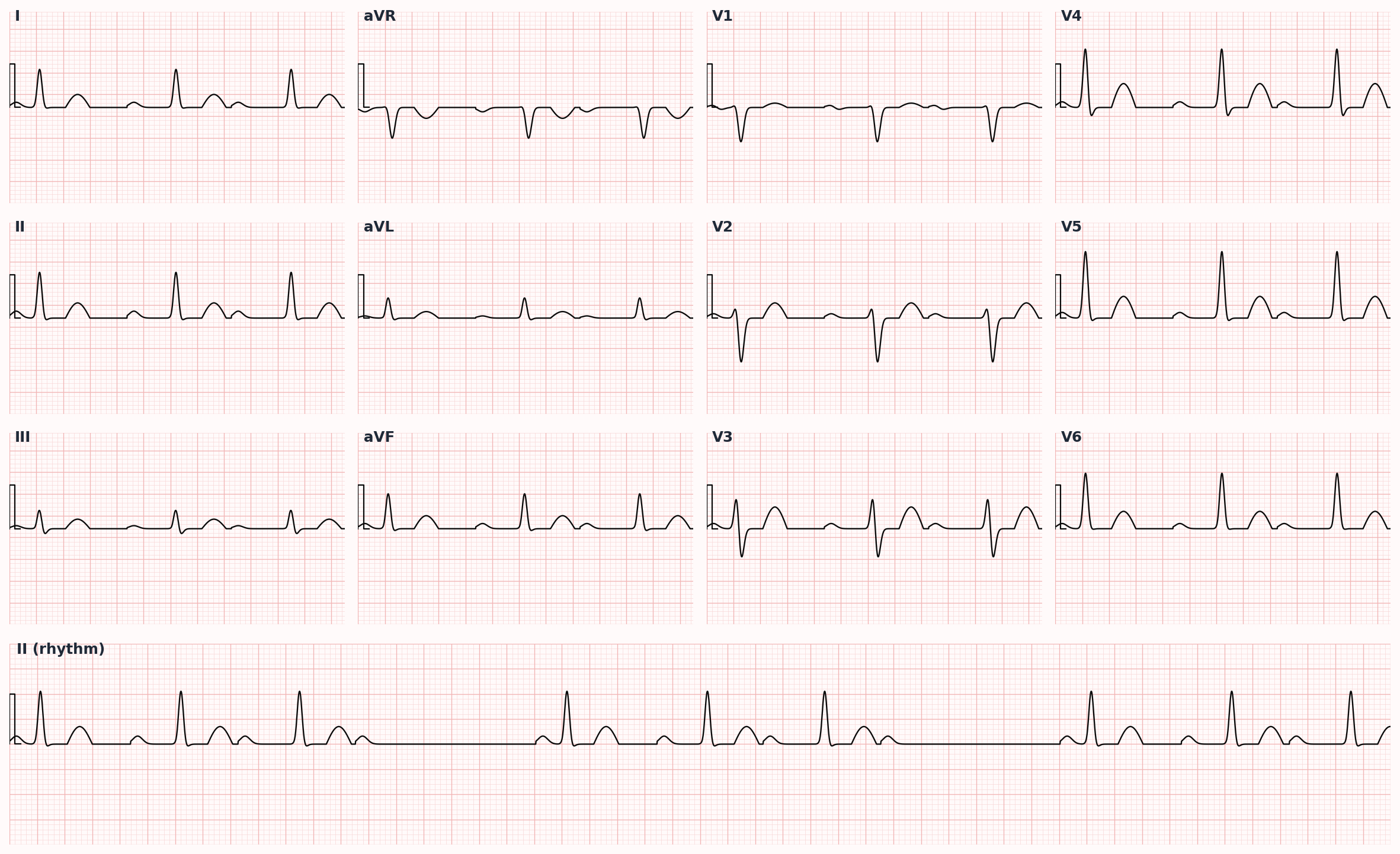
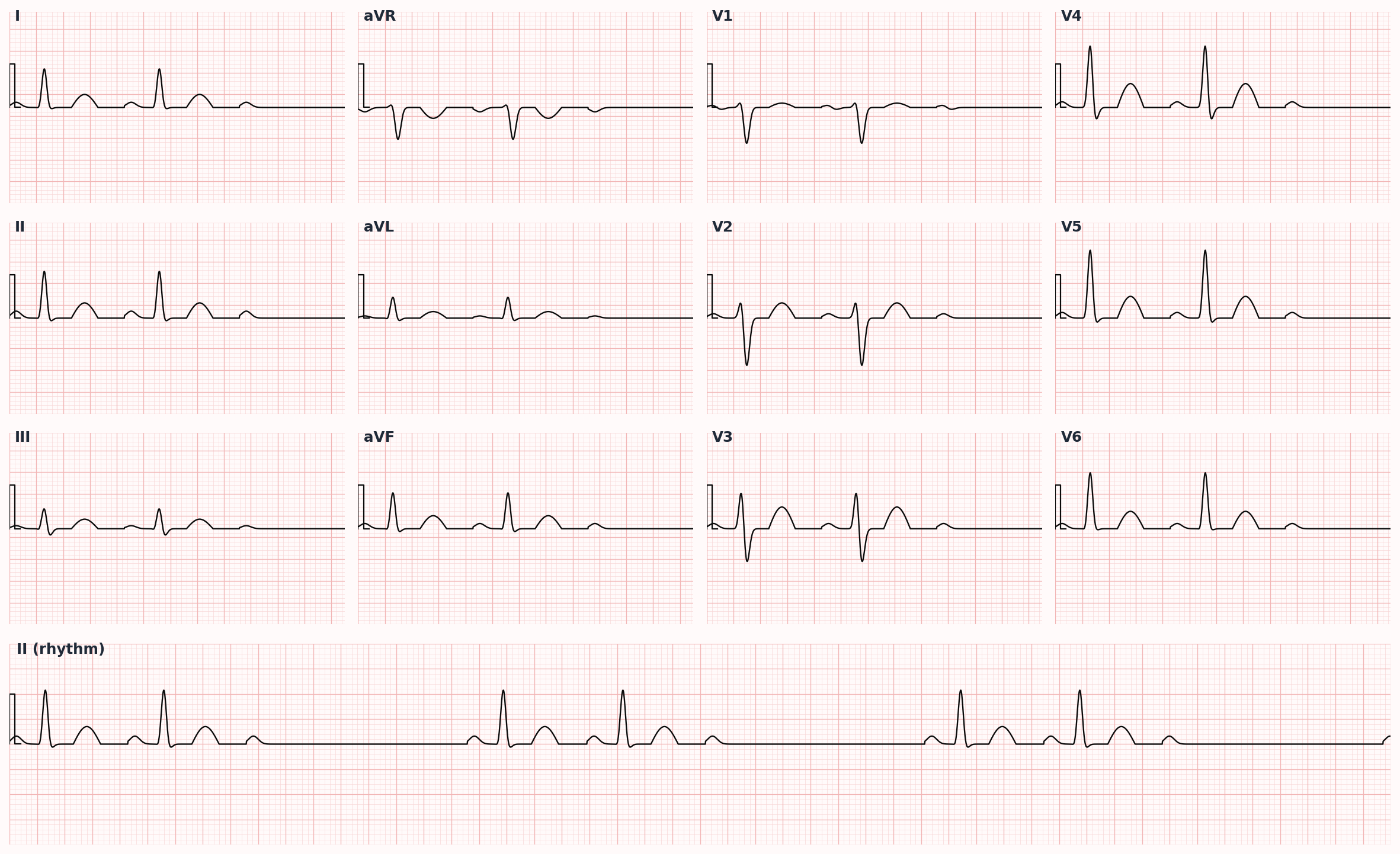
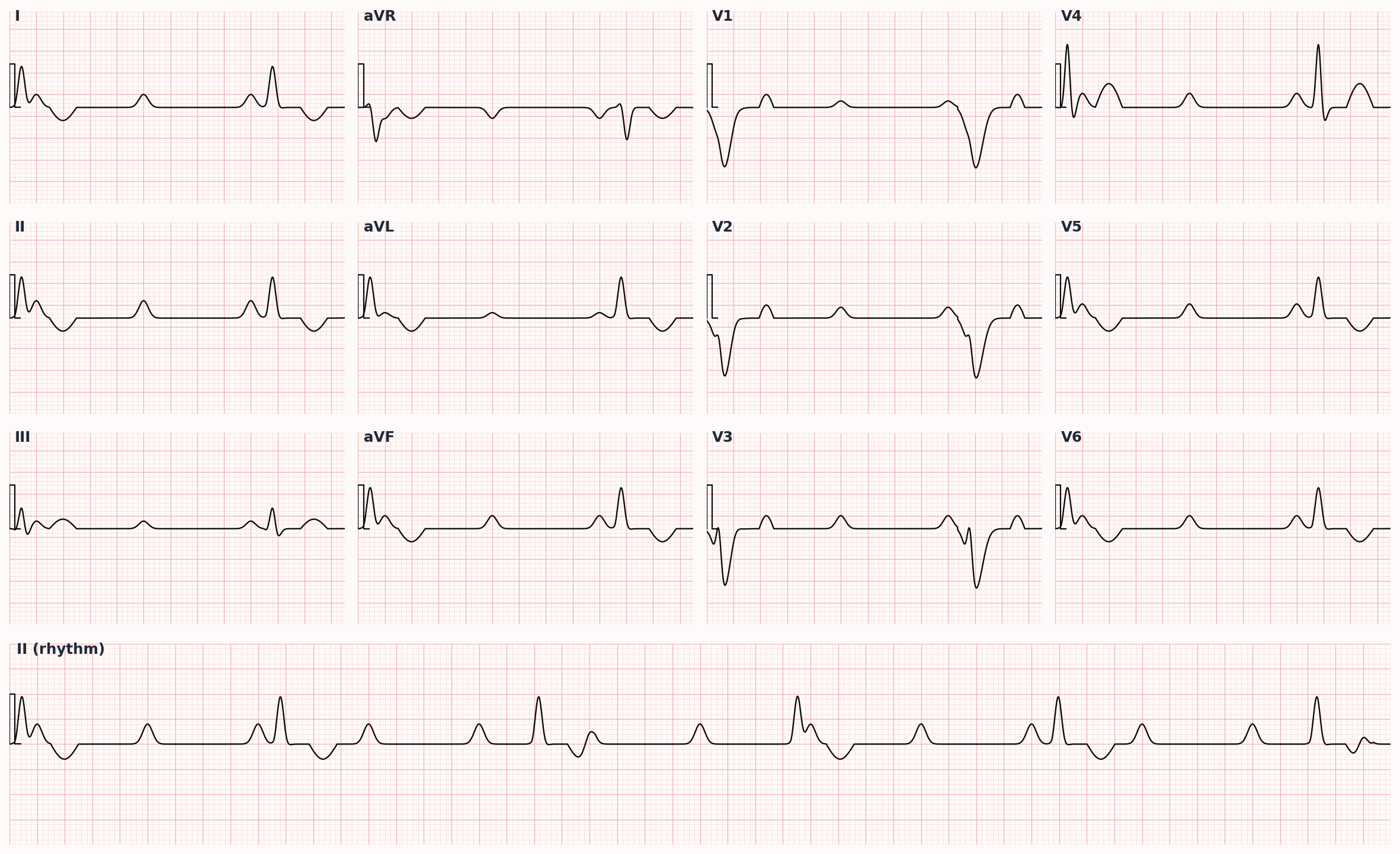
Disorders of conduction between atria and ventricles. First-degree: PR >200 ms with 1:1 conduction. Second-degree Mobitz I (Wenckebach): progressive PR prolongation until a non-conducted P wave. Mobitz II: constant PR with intermittent dropped beats. Third-degree (complete): AV dissociation with independent atrial and ventricular rates.
Epidemiology
Prevalence rises sharply with age and structural heart disease. Mobitz II and third-degree blocks reflect infranodal disease and are far more likely to progress to symptomatic or fatal bradycardia than nodal blocks.
Try two board-style Atrioventricular (AV) Blocks questions
Real questions from the FirstPassPA bank, with the full explanation. Pick an answer — no signup, no email.
Question 1CardiovascularEasy
A 78-year-old man reports one week of fatigue and several episodes of near-syncope. He takes no AV-nodal blocking medications. He is alert but ill-appearing; blood pressure is 96/58 mm Hg and the pulse is slow and regular at 34/min. A 12-lead ECG shows P waves marching out at 80/min completely independent of the QRS complexes, with a regular wide-complex escape rhythm at 34/min. Which of the following is the most appropriate definitive treatment?
APermanent pacemaker
BIntravenous atropine
CIsoproterenol infusion
DTranscutaneous pacing
Reveal answer & full explanation
Correct answer: A — Permanent pacemaker
APermanent pacemaker✓
BIntravenous atropine
CIsoproterenol infusion
DTranscutaneous pacing
Why Permanent pacemaker is correct
Atrioventricular dissociation (independent P waves at 80/min and a slower regular escape at 34/min) with symptoms (near-syncope, hypotension) is symptomatic complete (third-degree) AV block.
A permanent pacemaker is the only definitive therapy that restores reliable AV synchrony; symptomatic acquired third-degree block is a Class I pacing indication (per ACC/AHA/HRS bradycardia guidance).
Pharmacologic and external-pacing measures may stabilize the patient transiently but do not provide durable rhythm support.
Why the others are wrong
Intravenous atropine — a temporizing vagolytic that acts at the AV node and is typically ineffective in infranodal/complete block with a wide escape rhythm. Trap: premature closure on the reflexive ACLS bradycardia drug.
Isoproterenol infusion — a temporizing beta-agonist used to raise the escape rate; it is pro-arrhythmic and not definitive. Trap: right-diagnosis-wrong-step.
Transcutaneous pacing — an emergent bridge to definitive device therapy, not the definitive treatment itself. Trap: confusing the bridge with the destination.
Question 2CardiovascularEasy
A 72-year-old man has an ECG showing no relationship between P waves and QRS complexes. The atrial rate is 78 bpm and the ventricular rate is 38 bpm with wide QRS complexes. He is dizzy and his BP is 82/54. What is the immediate treatment?
ATranscutaneous pacing
BUrgent transvenous pacemaker placement
CIV atropine 1 mg
DIV calcium chloride
Reveal answer & full explanation
Correct answer: A — Transcutaneous pacing
ATranscutaneous pacing✓
BUrgent transvenous pacemaker placement
CIV atropine 1 mg
DIV calcium chloride
Why transcutaneous pacing is correct
This ECG shows complete (third-degree) atrioventricular (AV) block: no relationship between P waves and QRS complexes, atrial rate 78 bpm, ventricular rate 38 bpm with wide QRS complexes.
The patient is hemodynamically unstable (BP 82/54, dizzy), requiring immediate transcutaneous pacing to restore an adequate ventricular rate.
The wide-complex pattern suggests a ventricular escape rhythm at the level of the His-Purkinje system, which is less likely to respond to atropine (atropine may be tried first only in narrow-complex complete heart block with a junctional escape).
Definitive treatment is transvenous temporary pacing followed by permanent pacemaker implantation.
Why the others are wrong
Urgent transvenous pacemaker placement — the correct next step after stabilization, but line placement and positioning take time that a patient hypotensive now does not have; transcutaneous pacing is the bridge to it.
IV atropine 1 mg — may be tried in narrow-complex complete heart block, but this wide-complex ventricular escape rhythm is unlikely to respond; transcutaneous pacing takes priority in the unstable patient.
IV calcium chloride — reserved for bradycardia from hyperkalemia or calcium channel blocker toxicity; neither is suggested here, and it does not raise the rate in infranodal AV block.
🔒 Free preview limit reached
Keep reading — start your free trial
You've read your 2 free diagnosis previews. Create your free account to unlock the full Atrioventricular (AV) Blocks outline — plus all 514 diagnoses, 6,500+ board-style questions, flashcards, and an AI tutor. Your 7-day free trial includes everything, and there's no credit card required.
Conduction can fail in the AV node (typically Wenckebach — vagal influence, drug effect, ischemia from RCA territory) or in the His-Purkinje system below (Mobitz II and most complete blocks — fibrotic or ischemic). Nodal blocks are usually benign and responsive to atropine; infranodal blocks generally are not.
Clinical presentation
Symptoms
First-degree and Mobitz I: usually asymptomatic, incidental finding
Mobitz II and third-degree: fatigue, dyspnea, presyncope, syncope (Stokes-Adams attack), heart failure, angina
Worsening with negative chronotropic medications
Signs / physical exam
Bradycardia
Cannon A waves in third-degree block (atrial contraction against closed tricuspid valve)
Variable S1 intensity in third-degree block (AV dissociation)
Wide pulse pressure in complete heart block (large stroke volume)
Signs of heart failure in chronic high-grade block
Differential diagnosis
Sinus bradycardia — Slow but 1:1 conduction with normal PR; no dropped beats
Blocked premature atrial complex — Non-conducted P wave but P morphology differs from sinus and timing is premature
Vagally mediated AV block — Often nocturnal, asymptomatic, athletes; responds to exercise; benign
Junctional escape rhythm — Narrow QRS 40-60 bpm with no P or inverted retrograde P; backup rhythm in sinus arrest or complete block
Ventricular escape rhythm — Wide QRS 20-40 bpm; backup in complete heart block with infranodal disease
Atrial fibrillation with regularized slow ventricular rate — Suggests complete AV block with junctional/ventricular escape
Diagnostic workup
Diagnostic criteria
First-degree: PR interval >200 ms with each P followed by a QRS. Mobitz I: progressive PR prolongation, then a single dropped QRS; cycle repeats. Mobitz II: constant PR, sudden dropped QRS without prior PR change. Third-degree: complete AV dissociation, atrial rate exceeds ventricular rate, ventricular escape rhythm (junctional 40-60 narrow, or ventricular 20-40 wide).
Labs
BMP, magnesium, calcium, TSH
Troponin if ischemic etiology suspected
Digoxin level if applicable
Lyme serology, sarcoidosis workup in selected patients
Imaging
12-lead ECG — diagnostic; characterize PR and AV relationship
Cardiac MRI/PET if infiltrative cardiomyopathy or sarcoidosis suspected
Diagnostic algorithm
Type
ECG features
Site
Symptoms / risk
Pacing indication
First-degree
PR >200 ms, every P conducted
Usually AV node
Asymptomatic
Not indicated
Mobitz I (Wenckebach)
Progressive PR lengthening, then dropped QRS
AV node
Usually asymptomatic
Only if symptomatic
Mobitz II
Constant PR, sudden dropped QRS
Infranodal (His-Purkinje)
Syncope; high progression risk
Yes — Class I
High-grade (2:1 or worse)
≥2 consecutive blocked P waves
Variable
Bradycardia, syncope
Usually yes
Third-degree (complete)
AV dissociation; atrial rate > ventricular escape
Anywhere; usually infranodal
Syncope, sudden death
Yes — Class I
Classification of AV blocks with implications for pacing.
Treatment
First-line
Identify and remove reversible causes: hold AV nodal blockers, correct electrolytes, treat ischemia, treat Lyme
Asymptomatic first-degree and Mobitz I (with narrow QRS): no specific therapy, observation
Symptomatic bradycardia: atropine 0.5-1 mg IV q3-5 min up to 3 mg total (effective for nodal blocks, less so for infranodal)
Transcutaneous pacing for unstable symptomatic block as bridge to transvenous pacing
Dopamine 5-20 mcg/kg/min or epinephrine 2-10 mcg/min as alternatives if atropine fails
Second-line / adjunct
Permanent pacemaker (Class I) for: symptomatic Mobitz I or Mobitz II, any third-degree AV block (symptomatic or asymptomatic with significant escape pauses), advanced second-degree block
Permanent pacemaker (Class IIa) for: asymptomatic Mobitz II, asymptomatic high-grade block with average HR <40, alternating bundle branch block
Dual-chamber pacing preferred over single-chamber for sinus rhythm with intact atrial activity
Avoid permanent pacing for reversible causes (drug effect, electrolyte, Lyme — most resolve with treatment)
Cardiac resynchronization therapy if EF ≤35% and significant ventricular pacing burden expected
Complications
Syncope with injury (Stokes-Adams attack)
Sudden cardiac death from asystole or ventricular escape failure
Heart failure from chronic bradycardia and AV dyssynchrony
Pacemaker complications: lead displacement, infection, RV pacing-induced cardiomyopathy
Mobitz I (Wenckebach) with NARROW QRS is usually nodal and benign; Mobitz II is infranodal and warrants a pacemaker.
Atropine is effective for AV nodal blocks but may paradoxically worsen infranodal blocks by speeding atrial rate without improving conduction.
Inferior MI causes transient AV nodal block (RCA supplies AV node in ~90%) — usually resolves; rarely needs permanent pacing.
Anterior MI with new AV block reflects extensive infranodal damage and carries high mortality — often needs pacing.
Always check for reversible causes (drugs, Lyme, electrolytes) before committing a patient to a permanent pacemaker.
Images
First-degree AV block — PR interval prolonged >200 ms, every P wave conductedMobitz I (Wenckebach) — progressive PR prolongation until a dropped beatMobitz II — fixed PR interval with intermittent non-conducted P waves; high risk of progressionThird-degree (complete) AV block — AV dissociation; atrial and ventricular rates independent
References
ACC/AHA/HRS 2018 Bradycardia — 2018 ACC/AHA/HRS Guideline on the Evaluation and Management of Patients With Bradycardia and Cardiac Conduction Delay (Kusumoto et al., Circulation 2019)
ESC 2021 Pacing — 2021 ESC Guidelines on Cardiac Pacing and Cardiac Resynchronization Therapy (Glikson et al., Eur Heart J 2021)
Practice Cardiovascular questions on FirstPassPA
Turn this outline into retention. 6,500+ board-style questions with an AI tutor that explains every answer — free to start, no card required.
Educational use only. This outline is a study aid for PA students and is not medical advice or a substitute for clinical judgment. FirstPassPA is an independent study tool and is not affiliated with, endorsed by, or sponsored by NCCPA or PAEA. PANCE® and PANRE® are registered trademarks of the National Commission on Certification of Physician Assistants; End of Rotation™ is a program of the Physician Assistant Education Association.