Also known as: HTN, high blood pressure, essential hypertension, primary hypertension
Overview
Sustained elevation of arterial blood pressure ≥130/80 mmHg (ACC/AHA 2017 thresholds) based on average of ≥2 properly measured readings on ≥2 occasions. Stage 1: 130-139/80-89. Stage 2: ≥140/90. Hypertensive crisis: ≥180/120 (urgency if no end-organ damage; emergency if present).
Epidemiology
Affects nearly half of US adults under current guidelines. Leading modifiable risk factor for cardiovascular disease, stroke, CKD, and dementia worldwide.
Try two board-style Hypertension questions
Real questions from the FirstPassPA bank, with the full explanation. Pick an answer — no signup, no email.
Question 1CardiovascularMedium
A 62-year-old man presents with acute confusion and headache. His blood pressure is 218/128 mm Hg, fundoscopy shows papilledema, and his serum creatinine has risen acutely from 0.9 to 2.4 mg/dL. He is alert but disoriented to time and place. Which of the following is the most appropriate initial antihypertensive agent?
AOral nifedipine
BIntravenous nicardipine
CIntravenous furosemide
DOral captopril
Reveal answer & full explanation
Correct answer: B — Intravenous nicardipine
AOral nifedipine
BIntravenous nicardipine✓
CIntravenous furosemide
DOral captopril
Why Intravenous nicardipine is correct
This patient has a hypertensive emergency: severely elevated blood pressure with acute end-organ damage (encephalopathy with confusion, papilledema, and acute kidney injury).
The goal is a controlled, titratable reduction of mean arterial pressure by no more than about 25% in the first hour, then gradual normalization over 24-48 hours, because abrupt drops can cause cerebral, renal, or coronary hypoperfusion and ischemic stroke.
Intravenous nicardipine is a titratable dihydropyridine calcium channel blocker that allows this smooth, controlled reduction and is a guideline-preferred agent (labetalol is the other first-line choice).
Why the others are wrong
Oral nifedipine — oral immediate-release nifedipine causes a rapid, unpredictable, and uncontrolled blood pressure drop that has precipitated strokes and myocardial infarction; it is contraindicated in hypertensive emergencies.
Intravenous furosemide — treats volume overload and may be adjunctive in pulmonary edema, but this patient has no signs of fluid overload, and aggressive diuresis can worsen the hypoperfusion driving his acute kidney injury.
Oral captopril — has too slow and unpredictable an onset for an emergency requiring minute-to-minute titration, and an ACE inhibitor is risky in the setting of acute kidney injury.
Question 2CardiovascularMedium
A 48-year-old woman is evaluated for hypertension that has remained difficult to control on two agents. She takes no diuretics. Blood pressure is 168/104 mm Hg and serum potassium is 3.1 mEq/L with high-normal serum sodium. The plasma aldosterone-to-renin ratio is markedly elevated at 40. Renal function is normal and there are no cushingoid features. Which of the following is the most likely diagnosis?
AEssential hypertension
BPheochromocytoma
CRenovascular hypertension
DPrimary hyperaldosteronism
Reveal answer & full explanation
Correct answer: D — Primary hyperaldosteronism
AEssential hypertension
BPheochromocytoma
CRenovascular hypertension
DPrimary hyperaldosteronism✓
Why Primary hyperaldosteronism is correct
Resistant hypertension with spontaneous (non-diuretic) hypokalemia and a markedly elevated aldosterone-to-renin ratio is the classic screen-positive picture for primary hyperaldosteronism (Conn syndrome).
Autonomous aldosterone secretion drives sodium retention (hypertension, high-normal serum sodium) and renal potassium wasting (hypokalemia) while suppressing renin, producing the high ratio.
A positive screen is confirmed with an aldosterone-suppression test (saline infusion or fludrocortisone), then adrenal CT and adrenal venous sampling to localize (per Endocrine Society guidance).
Why the others are wrong
Essential hypertension — does not cause spontaneous hypokalemia or an elevated aldosterone-to-renin ratio. Trap: premature closure on the most common cause of hypertension while ignoring the potassium and the ratio.
Pheochromocytoma — catecholamine excess produces episodic hypertension with headache, palpitations, and diaphoresis; it does not suppress renin or raise the aldosterone-to-renin ratio, and spontaneous hypokalemia is not part of the syndrome. Trap: reaching for any secondary cause of resistant hypertension without matching the specific electrolyte and hormone pattern.
Renovascular hypertension — causes secondary hyperaldosteronism with HIGH renin, so the aldosterone-to-renin ratio is low or normal, not 40. Trap: confusing primary (low-renin) with secondary (high-renin) aldosteronism.
🔒 Free preview limit reached
Keep reading — start your free trial
You've read your 2 free diagnosis previews. Create your free account to unlock the full Hypertension outline — plus all 514 diagnoses, 6,500+ board-style questions, flashcards, and an AI tutor. Your 7-day free trial includes everything, and there's no credit card required.
Renal artery stenosis — Abdominal bruit, refractory HTN, ↑ creatinine after ACEi/ARB; FMD in young women, atherosclerotic in older men; renal artery Doppler or MRA
Hypertension drug selection by compelling indication. When comorbidities are present, the choice of antihypertensive should target both BP and the comorbid condition.
Chronic kidney disease — second leading cause of ESRD after diabetes
Hypertensive retinopathy
Aortic dissection
Hypertensive emergency with end-organ damage (encephalopathy, pulmonary edema, AKI)
PANCE pearls
Proper BP measurement: seated, back supported, feet flat, arm at heart level, no caffeine/exercise/smoking 30 min prior, appropriate cuff size. Average of ≥2 readings on ≥2 occasions.
ACEi cough (10-20% of patients, bradykinin-mediated) → switch to ARB. Angioedema → avoid both ACEi AND ARB (cross-reactivity ~10%).
Hypertensive urgency (≥180/120 no end-organ damage): oral therapy, gradual reduction over 24-48 h. Hypertensive emergency: IV therapy, reduce MAP 10-20% in first hour, then more gradually. Acute dissection: aggressive — SBP <120 in minutes.
Avoid sublingual nifedipine — unpredictable, can cause stroke or MI from rapid hypotension. Pulled from US market for this use decades ago.
Lower 'goal' to <130/80 in most patients per SPRINT (intensive control reduces CV events but increases AKI, syncope, electrolyte abnormalities).
Images
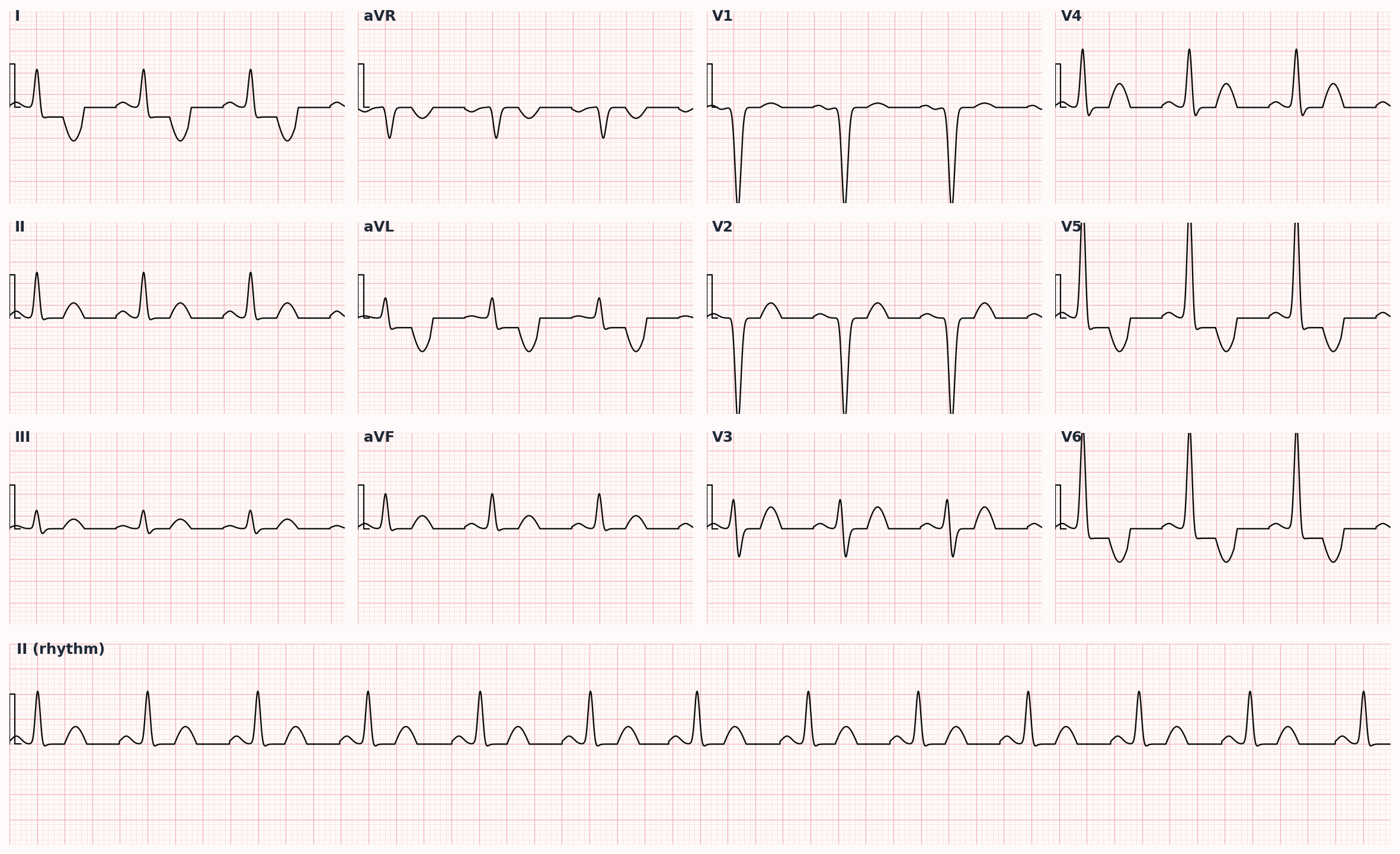
Left ventricular hypertrophy — chronic hypertension causes voltage criteria (Sokolow-Lyon, Cornell) and "strain" pattern
References
ACC/AHA 2017 — 2017 ACC/AHA Guideline for the Prevention, Detection, Evaluation, and Management of High Blood Pressure in Adults (Whelton et al., Hypertension 2018)
SPRINT — A Randomized Trial of Intensive versus Standard Blood-Pressure Control (SPRINT Research Group, NEJM 2015)
ALLHAT — Major Outcomes in High-Risk Hypertensive Patients Randomized to ACEi, CCB, or Thiazide (ALLHAT Officers, JAMA 2002)
PATHWAY-2 — Spironolactone vs Placebo, Bisoprolol, Doxazosin for Resistant HTN (Williams et al., Lancet 2015)
JNC 8 — 2014 Evidence-Based Guideline for the Management of High Blood Pressure (James et al., JAMA 2014)
Practice Cardiovascular questions on FirstPassPA
Turn this outline into retention. 6,500+ board-style questions with an AI tutor that explains every answer — free to start, no card required.
Educational use only. This outline is a study aid for PA students and is not medical advice or a substitute for clinical judgment. FirstPassPA is an independent study tool and is not affiliated with, endorsed by, or sponsored by NCCPA or PAEA. PANCE® and PANRE® are registered trademarks of the National Commission on Certification of Physician Assistants; End of Rotation™ is a program of the Physician Assistant Education Association.