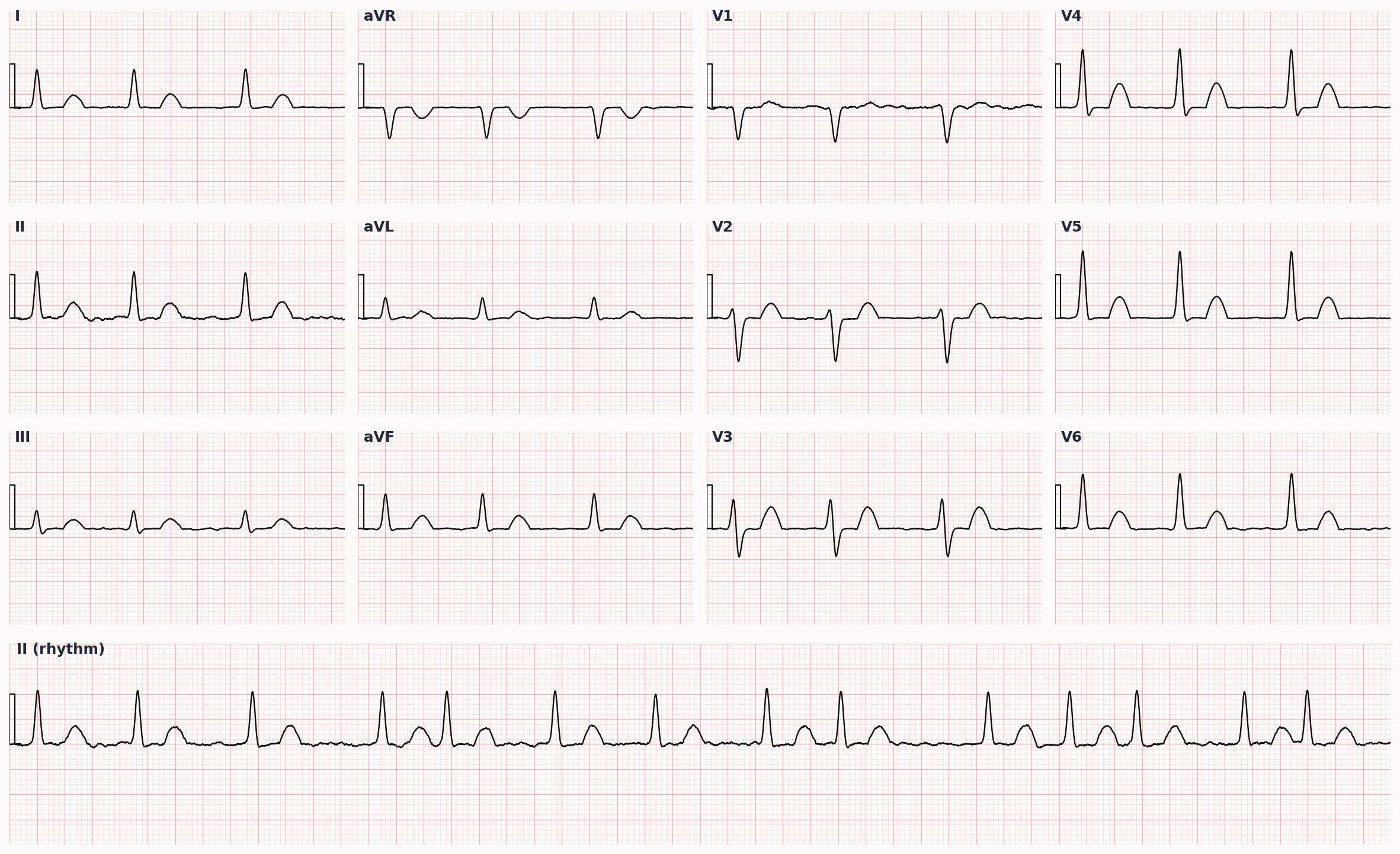
Most common sustained arrhythmia: irregularly irregular rhythm with no discrete P waves.
Also known as: AFib, AF, atrial fibrillation, irregularly irregular
Overview
Supraventricular tachyarrhythmia with chaotic atrial activation, producing an irregularly irregular ventricular response and absent discrete P waves on ECG. Classified as paroxysmal (terminates <7 days), persistent (>7 days requiring intervention), long-standing persistent (>12 months), or permanent (decision made not to restore sinus rhythm).
Epidemiology
Most common sustained arrhythmia. Prevalence rises sharply with age — ~10% in adults >80. Lifetime risk ~1 in 3 after age 55.
Try two board-style Atrial Fibrillation questions
Real questions from the FirstPassPA bank, with the full explanation. Pick an answer — no signup, no email.
Question 1CardiovascularEasy
A 70-year-old woman with non-valvular atrial fibrillation is rate-controlled and clinically stable. She has hypertension and type 2 diabetes mellitus, and her CHA₂DS₂-VASc score is 4. She has no mechanical heart valve and no moderate-to-severe mitral stenosis, and her renal function is normal. Which of the following is the most appropriate therapy for stroke prevention?
AClopidogrel
BAspirin
CWarfarin
DApixaban
Reveal answer & full explanation
Correct answer: D — Apixaban
AClopidogrel
BAspirin
CWarfarin
DApixaban✓
Why Apixaban is correct
For non-valvular atrial fibrillation with an elevated CHA₂DS₂-VASc score (here 4), oral anticoagulation is indicated, and direct oral anticoagulants such as apixaban are preferred over warfarin per the current ACC/AHA/ACCP/HRS atrial fibrillation guideline.
DOACs provide comparable or superior stroke prevention with less intracranial bleeding and no need for routine INR monitoring.
The absence of a mechanical valve or moderate-to-severe mitral stenosis means a DOAC, not warfarin, is the appropriate choice.
Why the others are wrong
Clopidogrel — an antiplatelet agent that does not provide adequate stroke prevention in atrial fibrillation; selecting it reflects confusing arterial-platelet disease with cardioembolic stroke (confused-with-ACS trap).
Aspirin — no longer recommended for stroke prevention in atrial fibrillation with an elevated risk score because it is far less effective than anticoagulation while still carrying bleeding risk (outdated-practice trap).
Warfarin — an effective anticoagulant but first-line only for a mechanical valve or moderate-to-severe mitral stenosis, both excluded here; a DOAC is otherwise preferred (right-drug-wrong-setting trap).
Question 2CardiovascularMedium
A 48-year-old man is found to have an irregularly irregular pulse at 85 beats/min. An ECG shows an irregularly irregular ventricular response with no discrete P waves. He denies palpitations, dyspnea, and chest pain. He has no hypertension, diabetes, heart failure, prior stroke, or vascular disease, and echocardiography shows no structural heart disease. His CHA₂DS₂-VASc score is 0. Which of the following is the most appropriate management to reduce stroke risk?
ANo antithrombotic therapy
BAspirin 81 mg once daily
CWarfarin with INR goal 2-3
DApixaban 5 mg twice daily
Reveal answer & full explanation
Correct answer: A — No antithrombotic therapy
ANo antithrombotic therapy✓
BAspirin 81 mg once daily
CWarfarin with INR goal 2-3
DApixaban 5 mg twice daily
Why No antithrombotic therapy is correct
This patient has atrial fibrillation (irregularly irregular rhythm, no discrete P waves) with a CHA₂DS₂-VASc score of 0 and no structural heart disease
Per current AHA/ACC/HRS guidance, oral anticoagulation is recommended for men with a score ≥2 and women with a score ≥3; at the lowest risk (men 0, women 1 from sex alone) bleeding risk outweighs any stroke-prevention benefit, so no antithrombotic therapy is advised
Risk factors should be reassessed periodically because the score rises with age and new comorbidities
Why the others are wrong
Aspirin 81 mg once daily — aspirin is no longer endorsed for atrial-fibrillation stroke prevention; it adds bleeding risk without meaningful protection (outdated-practice trap)
Warfarin with INR goal 2-3 — anticoagulation is not indicated at a CHA₂DS₂-VASc score of 0 and exposes a low-risk patient to bleeding (anchoring on the AF label rather than the risk score)
Apixaban 5 mg twice daily — a DOAC is appropriate when anticoagulation is indicated, but this patient's score does not meet that threshold (right-drug-wrong-patient)
🔒 Free preview limit reached
Keep reading — start your free trial
You've read your 2 free diagnosis previews. Create your free account to unlock the full Atrial Fibrillation outline — plus all 514 diagnoses, 6,500+ board-style questions, flashcards, and an AI tutor. Your 7-day free trial includes everything, and there's no credit card required.
Hyperthyroidism — always check TSH on new diagnosis
Obesity, obstructive sleep apnea
Alcohol use ('holiday heart'), stimulants
Diabetes, CKD
Pericarditis, recent cardiac surgery
Pathophysiology
Ectopic foci, typically arising from the pulmonary vein ostia, trigger multiple re-entrant wavelets in remodeled atrial tissue. Loss of organized atrial contraction reduces cardiac output by ~20% (loss of atrial kick) and promotes thrombus formation in the left atrial appendage — the substrate for embolic stroke.
Clinical presentation
Symptoms
Palpitations (most common)
Dyspnea, fatigue, exercise intolerance
Lightheadedness, presyncope; rarely syncope
Often asymptomatic — found incidentally on exam or wearable device
Acute presentation may be embolic stroke or decompensated HF
Signs / physical exam
Irregularly irregular pulse — pathognomonic on exam
Pulse deficit (apical-radial mismatch)
Variable S1 intensity beat-to-beat
Absent a-wave in JVP
Differential diagnosis
Atrial flutter with variable AV block — Sawtooth flutter waves (II, III, aVF) identify; can mimic AFib's irregularity when conduction ratio varies
Multifocal atrial tachycardia (MAT) — ≥3 distinct P-wave morphologies in same lead; typically COPD or hypoxic patient; treat underlying cause + non-DHP CCB
Atrial tachycardia with variable AV block — Single ectopic P-wave morphology (different from sinus); variable AV conduction creates irregularity
Frequent premature atrial contractions (PACs) — Irregular rhythm but discrete P waves visible (often abnormal morphology); usually benign in structurally normal hearts
Ventricular bigeminy or trigeminy — Wide-complex pattern with regular sequence; PVC after each (or every other) sinus beat
Sinus arrhythmia — Phasic variation with respiration in young/healthy patients; P-wave morphology preserved
Wandering atrial pacemaker — ≥3 P-wave morphologies but rate <100 (vs MAT >100); usually benign
Diagnostic workup
Labs
TSH (thyrotoxicosis), CBC, BMP, magnesium
Troponin if ischemia suspected
Coagulation studies prior to anticoagulation
Imaging
12-lead ECG: irregularly irregular RR, no P waves, narrow QRS (unless aberrancy/pre-existing BBB)
Holter or event monitor for paroxysmal AFib not captured on ECG
TTE: LA size, LV function, valve disease, LVH
TEE prior to cardioversion if >48 h duration or unknown onset and not therapeutically anticoagulated for ≥3 weeks
Diagnostic algorithm
flowchart TD
  A[New AFib<br/>diagnosis] --> B[Calculate<br/>CHA2DS2-VASc]
  B --> C{Score}
  C -->|Men ≥2<br/>Women ≥3| D[Anticoagulate]
  C -->|Men 0-1<br/>Women 0-2| E[Reassess<br/>periodically]
  D --> F{Valvular AFib?<br/>mech valve / mod-sev MS}
  F -->|Yes| G[Warfarin<br/>INR 2-3]
  F -->|No| H[DOAC preferred<br/>apixaban / rivaroxaban / edox / dabig]
  A --> I[Rate vs Rhythm<br/>strategy]
  I --> J[Rate Control<br/>BB or non-DHP CCB]
  I --> K[Rhythm Control<br/>cardiovert + AAD<br/>or PVI ablation]
AFib management: parallel decisions on stroke prevention (anticoagulation) and symptom management (rate vs rhythm).
Treatment
First-line
Acute rate control (HR <110 at rest is reasonable target; <80 for symptomatic):
• Warfarin required for mechanical valve or moderate-severe mitral stenosis ('valvular AFib')
Rhythm vs rate: rate-control is non-inferior in most patients (AFFIRM), but early rhythm control may improve outcomes in newly diagnosed AFib (EAST-AFNET 4)
Second-line / adjunct
Rhythm-control options:
• Cardioversion (electrical or pharmacologic) if hemodynamically unstable, or with adequate anticoagulation
• Antiarrhythmics: flecainide or propafenone (no structural heart disease); amiodarone (HF or CAD); sotalol, dofetilide
• Catheter ablation (pulmonary vein isolation) — symptomatic paroxysmal AFib refractory to ≥1 antiarrhythmic, or first-line for symptomatic patients per recent guidelines
Left atrial appendage occlusion (Watchman) for patients with stroke risk who cannot tolerate long-term anticoagulation
Complications
Embolic stroke (5× increased risk; ~15% of all ischemic strokes are AFib-related)
Tachycardia-induced cardiomyopathy from chronic rapid ventricular response
Heart failure decompensation
Anticoagulation-related bleeding
PANCE pearls
CHA2DS2-VASc: CHF (1), HTN (1), Age ≥75 (2), Diabetes (1), Stroke/TIA history (2), Vascular disease (1), Age 65-74 (1), Sex (female) (1). Score ≥2 men or ≥3 women → anticoagulate.
HAS-BLED estimates bleeding risk but does NOT exclude patients from anticoagulation — it identifies modifiable bleeding risk factors.
Cardioversion safety: <48 h from onset → cardiovert without prior AC. >48 h or unknown → either TEE-guided or 3 weeks AC first. Always anticoagulate ≥4 weeks after cardioversion regardless.
Wolf-Parkinson-White + AFib: AVOID AV-nodal blockers (BB, CCB, digoxin, adenosine) — can precipitate VF. Use procainamide or cardiovert.
Holiday heart syndrome: AFib triggered by acute alcohol binge; usually self-terminates with abstinence and supportive care.
Images
Atrial fibrillation — irregularly irregular rhythm with absent P waves and fibrillatory baseline
References
ACC/AHA/ACCP/HRS 2023 — 2023 ACC/AHA/ACCP/HRS Guideline for the Diagnosis and Management of Atrial Fibrillation (Joglar et al., Circulation 2024)
EAST-AFNET 4 — Early Rhythm-Control Therapy in Patients with Atrial Fibrillation (Kirchhof et al., NEJM 2020)
AFFIRM — A Comparison of Rate Control and Rhythm Control in AFib (Wyse et al., NEJM 2002)
CHA2DS2-VASc — Refining Clinical Risk Stratification for Stroke in AFib (Lip et al., Chest 2010)
Educational use only. This outline is a study aid for PA students and is not medical advice or a substitute for clinical judgment. FirstPassPA is an independent study tool and is not affiliated with, endorsed by, or sponsored by NCCPA or PAEA. PANCE® and PANRE® are registered trademarks of the National Commission on Certification of Physician Assistants; End of Rotation™ is a program of the Physician Assistant Education Association.