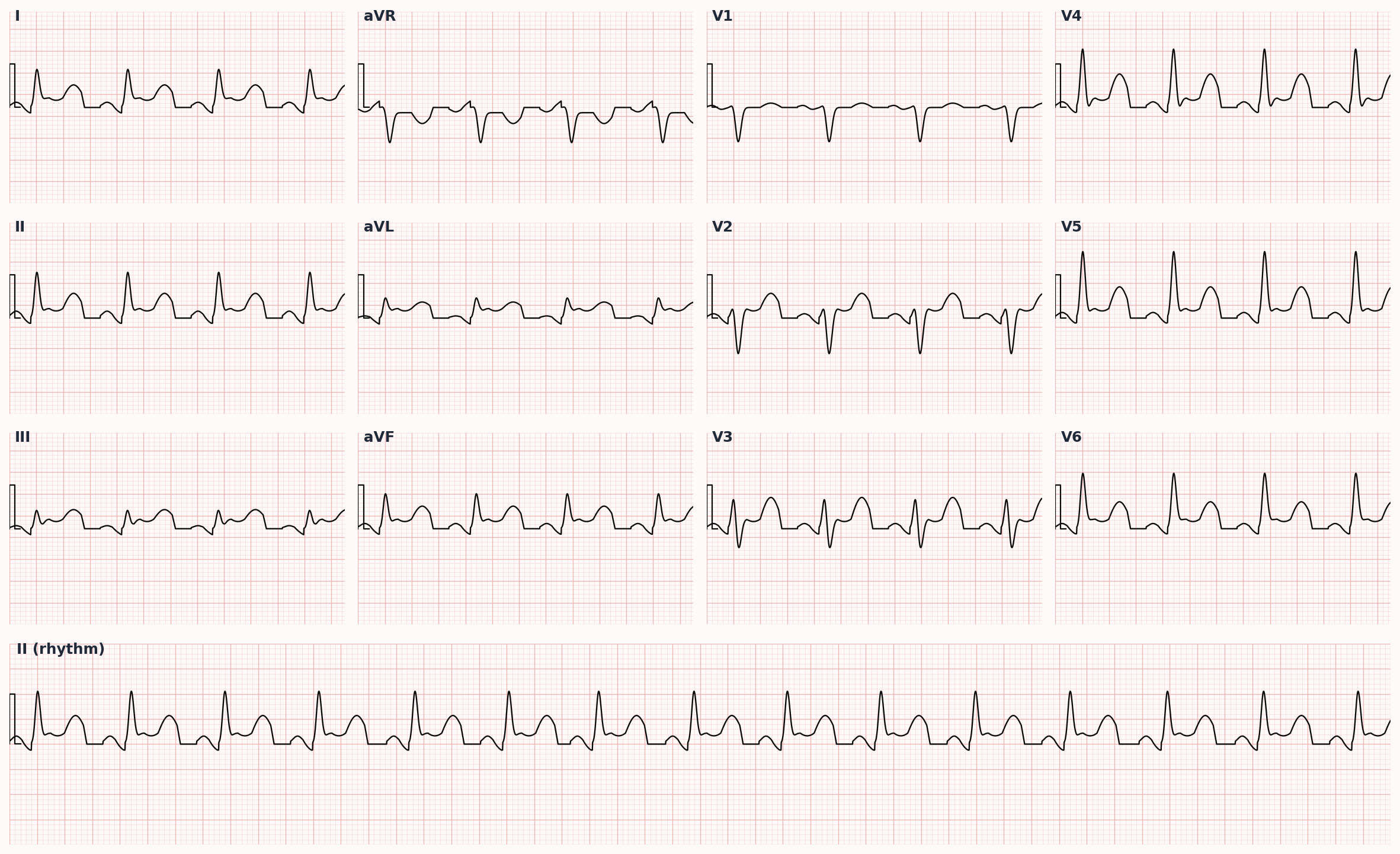
Inflammation of the pericardium — pleuritic chest pain improved by leaning forward, friction rub, diffuse ST elevation with PR depression.
Also known as: acute pericarditis, pericarditis, viral pericarditis
Overview
Inflammation of the pericardial sac with or without pericardial effusion, defined by at least 2 of: characteristic chest pain, pericardial friction rub, new widespread ST elevation or PR depression on ECG, or new/worsening pericardial effusion.
Epidemiology
Accounts for ~5% of ED chest pain visits with non-ischemic etiology. Most often idiopathic or viral; men 20-50 years most commonly affected.
Try two board-style Acute Pericarditis questions
Real questions from the FirstPassPA bank, with the full explanation. Pick an answer — no signup, no email.
Question 1CardiovascularMedium
A 44-year-old woman has 3 days of sharp left-sided chest pain that worsens when she lies flat and improves when she leans forward, two weeks after a viral upper respiratory illness. ECG shows diffuse ST-segment elevation with PR-segment depression. Troponin I is mildly elevated at 0.06 ng/mL (upper reference limit 0.04 ng/mL). Which of the following is the most likely diagnosis?
ACostochondritis
BMyopericarditis
CST-elevation myocardial infarction
DPulmonary embolism
Reveal answer & full explanation
Correct answer: B — Myopericarditis
ACostochondritis
BMyopericarditis✓
CST-elevation myocardial infarction
DPulmonary embolism
Why myopericarditis is correct
Positional, pleuritic chest pain (worse supine, better leaning forward) after a recent viral illness, with diffuse ST-segment elevation and PR-segment depression, is the classic picture of acute pericarditis
The mildly elevated troponin indicates accompanying myocardial inflammation, making this myopericarditis rather than isolated pericarditis
Management is NSAIDs plus colchicine, with activity restriction while myocardial involvement is present
Why the others are wrong
Costochondritis — reproducible chest-wall pain that does not cause diffuse ST elevation, PR depression, or troponin elevation (premature closure on a benign musculoskeletal cause)
ST-elevation myocardial infarction — coronary occlusion produces convex ST elevation confined to a vascular territory with reciprocal depression and a markedly higher troponin, not diffuse concave elevation with PR depression (anchoring on the ST elevation itself)
Pulmonary embolism — shares pleuritic pain, but the ECG would show sinus tachycardia or right-heart strain rather than diffuse ST elevation with PR depression (buzzword-matching pleuritic pain)
Question 2CardiovascularMedium
A 38-year-old man presents with 2 days of sharp, pleuritic chest pain that improves when he sits up and leans forward, 3 weeks after a viral upper respiratory infection. Temperature is 37.6°C. ECG shows diffuse saddle-shaped ST-segment elevation with PR-segment depression. Echocardiography shows a small pericardial effusion without chamber collapse. Troponin is normal. Which of the following is the most appropriate initial treatment?
AUrgent pericardiocentesis
BIntravenous antibiotics
CNSAIDs plus colchicine
DHigh-dose corticosteroids
Reveal answer & full explanation
Correct answer: C — NSAIDs plus colchicine
AUrgent pericardiocentesis
BIntravenous antibiotics
CNSAIDs plus colchicine✓
DHigh-dose corticosteroids
Why NSAIDs plus colchicine is correct
The picture is acute viral (idiopathic) pericarditis: pleuritic positional chest pain, low-grade fever, diffuse saddle-shaped ST elevation with PR depression, a small effusion, and normal troponin after a viral URI
First-line therapy is an NSAID at anti-inflammatory doses plus colchicine for 3 months, per current ESC pericardial disease guidance
Adding colchicine roughly halves the recurrence rate (COPE trial)
Activity restriction is advised until symptoms resolve and CRP normalizes
Why the others are wrong
Urgent pericardiocentesis — drainage is for tamponade, suspected purulent or malignant effusion, or large symptomatic effusions; a small effusion without chamber collapse needs none (trap: anchoring on the word "effusion")
Intravenous antibiotics — a post-viral presentation with low-grade fever and stable hemodynamics is viral, not purulent, pericarditis (trap: buzzword-matching fever to a bacterial infection)
High-dose corticosteroids — steroids increase the recurrence rate and are reserved for NSAID failure or contraindication, autoimmune disease, or uremic pericarditis (trap: right-diagnosis-wrong-step, reaching for the strongest anti-inflammatory first)
🔒 Free preview limit reached
Keep reading — start your free trial
You've read your 2 free diagnosis previews. Create your free account to unlock the full Acute Pericarditis outline — plus all 514 diagnoses, 6,500+ board-style questions, flashcards, and an AI tutor. Your 7-day free trial includes everything, and there's no credit card required.
Tuberculosis (most common cause worldwide in endemic regions)
Radiation therapy, certain drugs (hydralazine, procainamide, isoniazid)
Pathophysiology
Inflammation of the visceral and parietal pericardium produces increased capillary permeability, fibrin deposition, and exudate. The roughened layers generate friction rub. Sympathetic involvement of the diaphragm (phrenic nerve) causes referred shoulder/trapezius pain. Inflammation may extend to the epicardium (myopericarditis) or produce significant effusion.
Clinical presentation
Symptoms
Sharp, pleuritic, retrosternal or left precordial chest pain
Worse supine, better leaning forward
Radiation to trapezius ridge (highly specific — phrenic nerve)
Low-grade fever, dyspnea, fatigue
Antecedent viral prodrome (URI, GI symptoms) common
Signs / physical exam
Pericardial friction rub — three-component, scratchy, best at LLSB with patient leaning forward
Tachycardia
Low-grade fever
Signs of effusion (muffled heart sounds, Beck triad) if progressing to tamponade
Differential diagnosis
Acute coronary syndrome / STEMI — Regional (not diffuse) ST elevation with reciprocal changes; high troponin; risk factor profile
Pulmonary embolism — Pleuritic pain with dyspnea and hypoxia; S1Q3T3, right heart strain; D-dimer / CTPA
CBC, CRP, ESR (elevated CRP supports diagnosis and guides response to therapy)
BMP, BUN/Cr (uremic etiology)
ANA, RF, TSH if autoimmune cause suspected; HIV and TB testing in appropriate populations
Blood cultures if febrile and effusion present
Imaging
12-lead ECG — diffuse concave ST elevation with PR segment depression (PR elevation in aVR is reciprocal — early sign)
Echocardiography — assess for pericardial effusion and ventricular function (rule out tamponade and myocarditis)
CXR — typically normal; cardiomegaly only with large effusion
Cardiac MRI — late gadolinium enhancement of pericardium; useful for myopericarditis or recurrent disease
Chest CT for suspected purulent or constrictive disease
Diagnostic algorithm
Feature
Pericarditis
STEMI
Early repolarization
ST elevation distribution
Diffuse, concave
Regional, convex
Often precordial
PR depression
Present (PR elevation in aVR)
Absent
Absent
Reciprocal ST depression
Absent (except aVR, V1)
Present
Absent
Q waves
Absent
May develop
Absent
Troponin
Normal or mildly elevated
Markedly elevated
Normal
Evolution
Diffuse ST resolves over days then T inversion
ST resolves, Q waves and T inversion form
Stable over time
ECG and biomarker comparison: pericarditis vs STEMI vs benign early repolarization.
Treatment
First-line
NSAIDs — ibuprofen 600-800 mg PO TID × 1-2 weeks then taper, OR aspirin 750-1000 mg PO TID (preferred post-MI pericarditis)
Colchicine 0.5 mg PO BID (0.5 mg daily if <70 kg) × 3 months — added to NSAID for FIRST episode reduces recurrence (COPE / ICAP trials)
Proton pump inhibitor while on high-dose NSAIDs
Activity restriction until symptoms resolve and CRP normalizes (≥3 months for athletes with myopericarditis)
Treat underlying cause: dialysis for uremia, antimicrobials for purulent, TB therapy if confirmed
Second-line / adjunct
Corticosteroids (prednisone 0.25-0.5 mg/kg/day with slow taper) — reserved for NSAID/colchicine failure, contraindication, or specific etiologies (autoimmune, uremic) — increases recurrence risk in idiopathic disease
Educational use only. This outline is a study aid for PA students and is not medical advice or a substitute for clinical judgment. FirstPassPA is an independent study tool and is not affiliated with, endorsed by, or sponsored by NCCPA or PAEA. PANCE® and PANRE® are registered trademarks of the National Commission on Certification of Physician Assistants; End of Rotation™ is a program of the Physician Assistant Education Association.