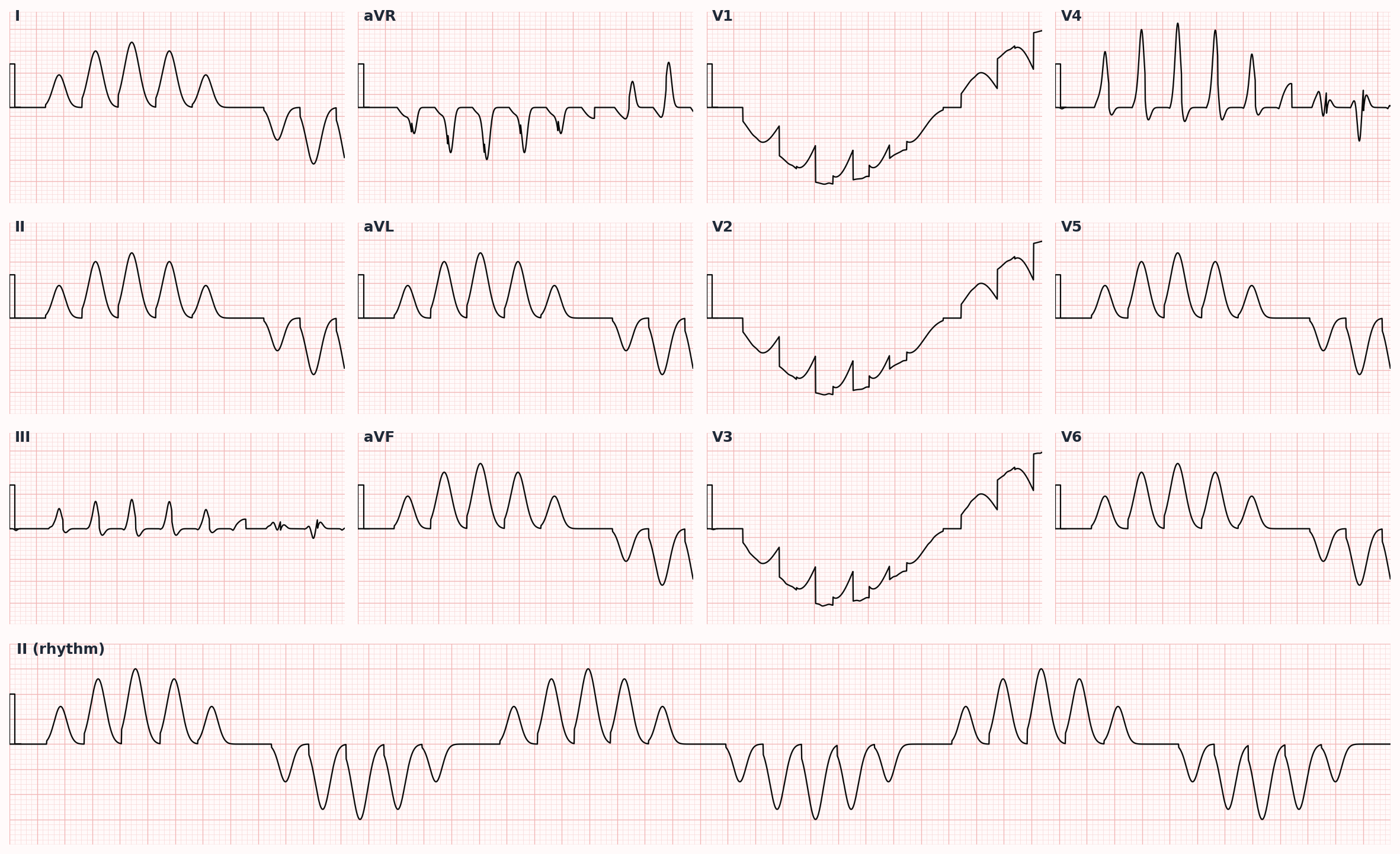
Inherited (or acquired) channelopathies causing prolonged QT (LQTS) or RBBB-like ST elevation (Brugada) — both predispose to polymorphic VT and sudden cardiac death.
Also known as: LQTS, long QT syndrome, torsades de pointes, Brugada syndrome, channelopathy
Overview
Inherited channelopathies of cardiac repolarization producing characteristic ECG patterns and predisposing to malignant ventricular arrhythmias. Long QT syndrome (LQTS) features prolonged ventricular repolarization (corrected QT interval) and risk of torsades de pointes; acquired forms are commonly drug- or electrolyte-induced. Brugada syndrome features a coved-type ST elevation in V1-V2 with risk of polymorphic VT or ventricular fibrillation, often during sleep or febrile illness.
Epidemiology
LQTS: prevalence ~1 in 2,000; LQT1, LQT2, and LQT3 account for ~75% of genotyped cases. Brugada syndrome: prevalence ~5 per 10,000 in Europeans, much higher in Southeast Asia (lai tai, pokkuri, bangungut — historically a leading cause of sudden death in young men). Brugada is more common in males ~8-10:1.
Try two board-style Long QT Syndrome and Brugada Syndrome questions
Real questions from the FirstPassPA bank, with the full explanation. Pick an answer — no signup, no email.
Question 1CardiovascularMedium
A 28-year-old man is resuscitated after collapsing during sleep from sudden cardiac arrest. He has no history of structural heart disease, and his father died suddenly at age 35. His resting ECG demonstrates coved ST-segment elevation of at least 2 mm followed by a negative T wave in leads V1 and V2 with a right bundle branch block-like pattern. Genetic testing identifies a loss-of-function mutation in the SCN5A cardiac sodium channel gene. Which of the following is the most likely diagnosis?
AArrhythmogenic right ventricular cardiomyopathy
BBrugada syndrome
CHypertrophic cardiomyopathy
DLong QT syndrome
Reveal answer & full explanation
Correct answer: B — Brugada syndrome
AArrhythmogenic right ventricular cardiomyopathy
BBrugada syndrome✓
CHypertrophic cardiomyopathy
DLong QT syndrome
Why Brugada syndrome is correct
Brugada syndrome is caused by loss-of-function mutations in the SCN5A cardiac sodium channel gene, exactly as identified here.
The type 1 pattern—coved ST-segment elevation of at least 2 mm with a negative T wave in V1–V2 and a right bundle branch block-like morphology—is the diagnostic ECG hallmark.
Life-threatening ventricular arrhythmias characteristically strike at rest, during sleep, or with fever, fitting this nocturnal arrest.
An implantable cardioverter-defibrillator is the only proven therapy; sodium channel blockers and fever should be avoided.
Why the others are wrong
Arrhythmogenic right ventricular cardiomyopathy — also causes young sudden death but is a desmosomal (e.g., PKP2) disease with epsilon waves and T-wave inversions in V1–V3, not coved ST elevation or an SCN5A mutation; buzzword-matching on 'right-sided ECG changes.'
Hypertrophic cardiomyopathy — a sarcomeric disease causing exertional (not sleep) sudden death with LV hypertrophy on ECG, not the SCN5A/coved-ST picture; premature closure on 'young sudden death.'
Long QT syndrome — some forms are SCN5A-linked (LQT3), but it produces a prolonged QT interval, not coved ST elevation with RBBB morphology; confused-with trap on the shared gene.
Question 2CardiovascularMedium
A 40-year-old man is found to have a Type 1 Brugada ECG pattern after presenting with syncope. He has two children and three living siblings. Which recommendation regarding his family is most appropriate?
AObservation without family screening
BECG screening of all first-degree relatives
CECG screening of male relatives only
DECG screening of symptomatic relatives only
Reveal answer & full explanation
Correct answer: B — ECG screening of all first-degree relatives
AObservation without family screening
BECG screening of all first-degree relatives✓
CECG screening of male relatives only
DECG screening of symptomatic relatives only
Why ECG screening of all first-degree relatives is correct
Brugada syndrome is autosomal dominant with variable expression and incomplete penetrance, so first-degree relatives carry a substantial risk of inheriting the same arrhythmic substrate.
Guidelines recommend ECG screening of all first-degree relatives of an affected proband, regardless of symptoms, with provocative drug testing or genetic testing in selected cases.
Why the others are wrong
A) Observation without family screening — given autosomal dominant inheritance, withholding screening places at-risk relatives in danger of undetected arrhythmic substrate.
C) ECG screening of male relatives only — although clinical events are more common in males, females can be affected and warrant screening.
D) ECG screening of symptomatic relatives only — incomplete penetrance means asymptomatic relatives can still harbor the mutation and be at risk; symptom-based screening would miss them.
🔒 Free preview limit reached
Keep reading — start your free trial
You've read your 2 free diagnosis previews. Create your free account to unlock the full Long QT Syndrome and Brugada Syndrome outline — plus all 514 diagnoses, 6,500+ board-style questions, flashcards, and an AI tutor. Your 7-day free trial includes everything, and there's no credit card required.
LQTS: family history of sudden death or unexplained syncope; congenital deafness (Jervell-Lange-Nielsen syndrome, LQT1 with autosomal recessive deafness)
Brugada: family history of unexplained sudden death; fever (key trigger); sodium channel blockers (flecainide, propafenone, certain antidepressants); cocaine; vagotonic states (sleep, large meals)
Pathophysiology
LQTS results from mutations affecting cardiac repolarization channels: KCNQ1 (LQT1, slow delayed rectifier potassium current IKs), KCNH2 (LQT2, rapid delayed rectifier IKr), and SCN5A (LQT3, late sodium current INa). Prolonged action potential predisposes to early afterdepolarizations and triggered activity, generating torsades de pointes. Acquired LQTS most often results from drugs blocking the IKr (hERG) channel. Brugada syndrome is associated with SCN5A loss-of-function mutations affecting the cardiac sodium channel, producing transmural voltage gradients in the right ventricular outflow tract that promote phase 2 reentry and polymorphic VT.
Clinical presentation
Symptoms
Recurrent unexplained syncope, especially in childhood or young adulthood
Documented or suspected torsades de pointes / polymorphic VT
Sudden cardiac death (may be the first manifestation)
Brugada: arrhythmic events often during sleep or fever; nocturnal agonal respiration
Seizure (often a misdiagnosis of arrhythmic syncope)
Family history of premature sudden death (<40 years)
Signs / physical exam
Exam is generally normal between events
Bradycardia in LQT3 patients (prolongs QT further)
Congenital sensorineural deafness in Jervell-Lange-Nielsen syndrome (LQTS)
Classic findings
Adolescent or young adult with exertional syncope and prolonged QTc (LQT1); young male with nocturnal sudden death and coved ST elevation in V1-V2 (Brugada Type 1).
Differential diagnosis
Acquired vs congenital LQTS — Medication review, electrolytes, family history; targeted genetic testing if congenital suspected
Catecholaminergic polymorphic VT (CPVT) — Exercise- or emotion-induced bidirectional or polymorphic VT with normal resting ECG; RYR2 or CASQ2 mutations
Short QT syndrome — QTc <340 ms with risk of AFib and sudden death; rare
Early repolarization syndrome — J-point elevation in inferior or lateral leads; small additional sudden death risk; rarely needs ICD
Right bundle branch block (true) — Brugada Type 1 ECG differs by coved ST elevation and inverted T wave in V1-V2; flecainide or ajmaline provocation if uncertain
ARVC (arrhythmogenic right ventricular cardiomyopathy) — Epsilon waves, T-wave inversion V1-V3, structural RV disease on MRI
Pulmonary embolism — Acute RV strain, S1Q3T3, but coved ST elevation V1-V2 is not the typical pattern
Diagnostic workup
Diagnostic criteria
Schwartz score for LQTS combines QTc duration, history of torsades, syncope (with/without stress), family history, and congenital deafness. Brugada syndrome is diagnosed by a spontaneous or drug-induced Type 1 pattern in ≥1 right precordial lead, plus clinical features per the 2013 HRS/EHRA/APHRS expert consensus.
Labs
BMP including potassium, magnesium, calcium
TSH
Toxicology screen if drug-induced arrhythmia suspected
Imaging
12-lead ECG with manual QT measurement and Bazett or Fridericia correction (Bazett: QTc = QT / √RR). Normal QTc <450 ms in men and <460 ms in women; LQTS strongly suspected if QTc ≥480 ms or borderline (450-480) with clinical risk factors
Brugada ECG patterns: Type 1 (coved-type ≥2 mm ST elevation followed by negative T wave in V1-V2) is diagnostic; Type 2 (saddleback) is suggestive but not diagnostic, may require provocation
Exercise stress testing and ambulatory monitoring
Echocardiography to exclude structural disease
Sodium channel blocker challenge (procainamide, ajmaline, flecainide) under monitored conditions to unmask Brugada Type 1 ECG when suspicion is high but resting ECG is non-diagnostic
Genetic testing (especially when ECG diagnostic): KCNQ1, KCNH2, SCN5A panels for LQTS; SCN5A for Brugada (positive in only ~20-30% of Brugada — clinical and ECG diagnosis remains primary)
Side-by-side comparison of LQTS and Brugada syndrome.
Treatment
First-line
LQTS — lifestyle: avoid QT-prolonging drugs (consult www.crediblemeds.org), maintain normal potassium/magnesium, avoid triggers based on genotype (e.g., competitive swimming in LQT1, sudden loud noises in LQT2)
LQTS — beta-blocker (nadolol or propranolol preferred over selective agents) for all symptomatic patients and most asymptomatic patients with QTc ≥470 ms — first-line therapy; titrate to attenuate exercise heart rate response
LQTS — ICD: aborted cardiac arrest, recurrent syncope on adequate beta-blockade, or very high-risk genotype/QTc combinations
LQTS — left cardiac sympathetic denervation (LCSD) for high-risk patients with breakthrough events on beta-blocker
Acute torsades de pointes: IV magnesium 2 g over 5-15 min (regardless of magnesium level), correct hypokalemia, withdraw offending agents, overdrive pacing or isoproterenol (if no contraindication and not LQTS-related) for pause-dependent torsades, defibrillate sustained VT/VF
Brugada — ICD is the only therapy proven to prevent sudden cardiac death; indicated for cardiac arrest survivors, documented sustained VT, or spontaneous Type 1 ECG with syncope or family history of SCD
Brugada — quinidine for ICD storm or for patients with high-risk features who are not ICD candidates
Brugada — substrate ablation of the RV outflow tract epicardium for recurrent VT or refractory ICD shocks in expert centers
Family screening with ECG ± genetic testing for first-degree relatives in both LQTS and Brugada
Complications
Polymorphic VT, torsades de pointes, ventricular fibrillation
Sudden cardiac death
ICD shocks (appropriate and inappropriate), psychological impact, complications of device therapy
Drug interactions in patients on chronic medications who must avoid QT-prolonging therapies (e.g., azithromycin, ondansetron)
PANCE pearls
Always measure QTc manually — automated QT measurements are unreliable. Use the lead with the clearest T-wave end (often II or V5) and apply Bazett (or Fridericia at extreme heart rates).
Acute torsades: IV magnesium FIRST, regardless of serum magnesium level; then correct potassium, remove offending drugs, and consider overdrive pacing for pause-dependent forms.
Brugada Type 1 ECG (coved-type) is diagnostic; fever frequently unmasks the pattern — counsel patients to be aggressive with antipyretics.
Family screening (ECG ± genetic testing) is essential in both LQTS and Brugada — first-degree relatives should be offered evaluation.
Images
Torsades de pointes — the feared arrhythmia complication of long QT syndrome
References
HRS/EHRA/APHRS 2013 — HRS/EHRA/APHRS Expert Consensus Statement on the Diagnosis and Management of Patients with Inherited Primary Arrhythmia Syndromes (Priori et al., Heart Rhythm 2013)
ACC/AHA/HRS 2017 — 2017 ACC/AHA/HRS Guideline for Management of Patients With Ventricular Arrhythmias and Prevention of Sudden Cardiac Death (Al-Khatib et al., JACC 2018)
ESC 2022 — 2022 ESC Guidelines for the Management of Patients with Ventricular Arrhythmias and the Prevention of Sudden Cardiac Death (Zeppenfeld et al., Eur Heart J 2022)
Educational use only. This outline is a study aid for PA students and is not medical advice or a substitute for clinical judgment. FirstPassPA is an independent study tool and is not affiliated with, endorsed by, or sponsored by NCCPA or PAEA. PANCE® and PANRE® are registered trademarks of the National Commission on Certification of Physician Assistants; End of Rotation™ is a program of the Physician Assistant Education Association.