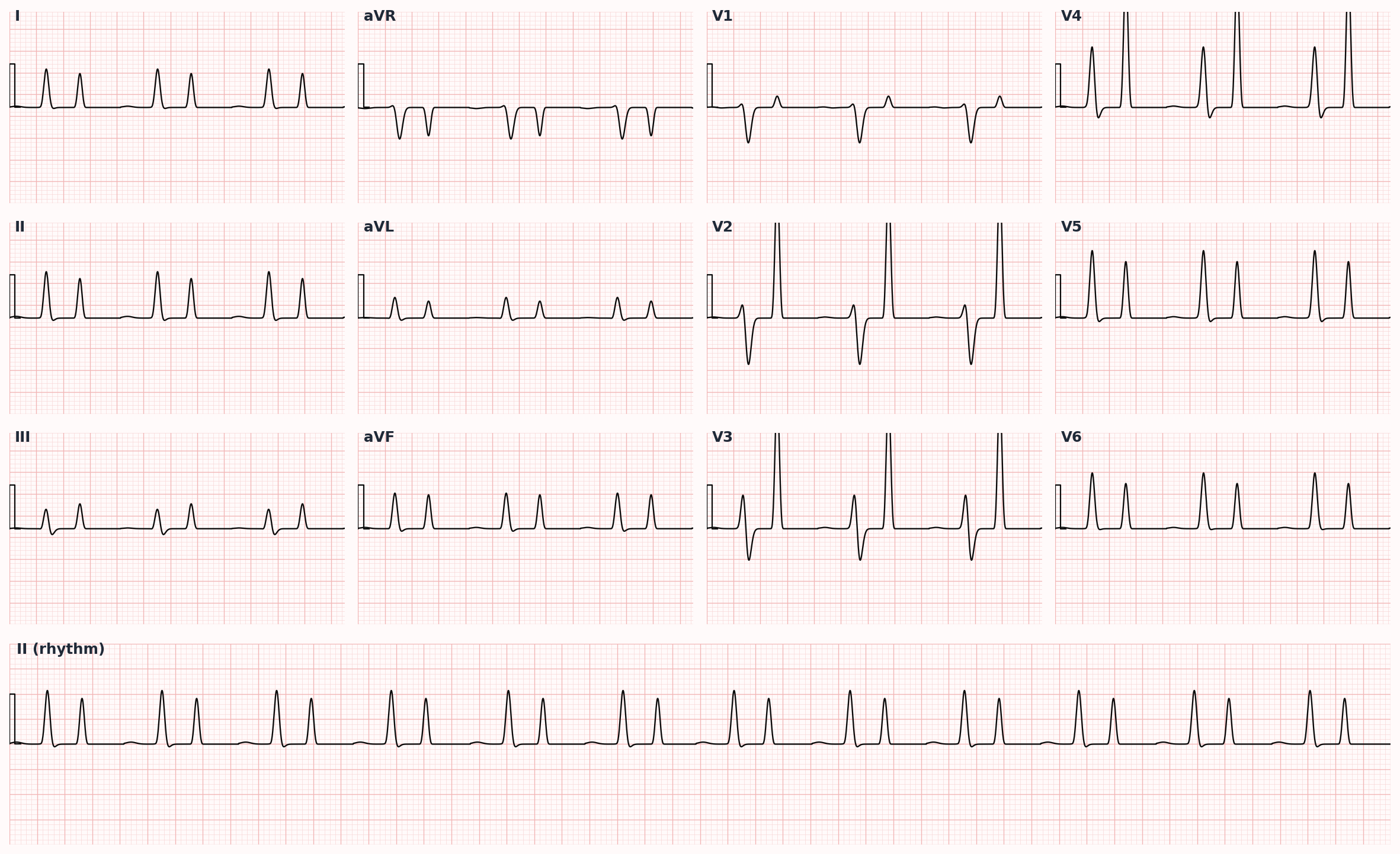
Serum K >5.0 mEq/L; cardiac arrhythmia risk drives urgent intervention.
Also known as: hyperkalemia, high potassium
Overview
Serum potassium concentration >5.0-5.5 mEq/L (varies by lab). Severity: mild 5.5-6.0, moderate 6.1-6.9, severe ≥7.0 or any level with ECG changes. Acuity, EKG changes, and underlying cause determine urgency of intervention.
Epidemiology
Affects ~1-10% of hospitalized patients. Most common in patients with CKD, heart failure, diabetes, and those on RAAS inhibitors, MRAs, or potassium-sparing diuretics.
Try two board-style Hyperkalemia questions
Real questions from the FirstPassPA bank, with the full explanation. Pick an answer — no signup, no email.
Question 1RenalMedium
A 67-year-old man with end-stage renal disease on hemodialysis presents with generalized weakness after missing dialysis. Blood pressure is 88/60 mm Hg and he appears ill. The ECG shows peaked T waves, a widened QRS of 160 ms, and a sine-wave pattern. Serum potassium is 7.8 mEq/L. Which of the following is the most appropriate immediate treatment?
AIV calcium gluconate
BIV sodium bicarbonate
COral sodium polystyrene sulfonate
DIV furosemide
Reveal answer & full explanation
Correct answer: A — IV calcium gluconate
AIV calcium gluconate✓
BIV sodium bicarbonate
COral sodium polystyrene sulfonate
DIV furosemide
Why IV calcium gluconate is correct
Severe hyperkalemia (potassium 7.8 mEq/L) with a sine-wave QRS and a widened complex represents peri-arrest cardiac membrane instability that demands immediate stabilization.
IV calcium gluconate antagonizes the membrane effects of hyperkalemia within minutes, restoring the resting membrane potential gradient and preventing degeneration into ventricular fibrillation or asystole.
It does not lower the serum potassium; it buys time while potassium-shifting and potassium-removing therapies are started.
In an end-stage renal disease patient, emergent hemodialysis is the definitive step once the membrane is stabilized.
Why the others are wrong
IV sodium bicarbonate — shifts potassium intracellularly but acts over 15-30 minutes and is unreliable in dialysis-dependent patients; choosing it first is right-problem-wrong-step, addressing the level before stabilizing the membrane.
Oral sodium polystyrene sulfonate — removes potassium through the gut over hours, far too slow for a peri-arrest rhythm; a buzzword-match to 'lower the potassium' that ignores the time course.
IV furosemide — promotes renal potassium excretion, but an anuric end-stage renal disease patient cannot respond, making it ineffective (premature closure on a reflexive diuretic).
Question 2RenalMedium
A 62-year-old man with chronic kidney disease (CKD) stage 3b (eGFR 32) has BP 156/96 and serum potassium 5.6 mEq/L on lisinopril and amlodipine. Repeat potassium in 2 weeks is 5.8 mEq/L and ECG shows peaked T waves. What is the most appropriate immediate management?
AIV calcium gluconate then insulin-dextrose
BEmergent intermittent hemodialysis
CIncreased lisinopril dose escalation
DDietary potassium restriction and furosemide
Reveal answer & full explanation
Correct answer: A — IV calcium gluconate then insulin-dextrose
AIV calcium gluconate then insulin-dextrose✓
BEmergent intermittent hemodialysis
CIncreased lisinopril dose escalation
DDietary potassium restriction and furosemide
Why IV calcium gluconate then insulin-dextrose is correct
Potassium 5.8 mEq/L with ECG changes (peaked T waves) represents symptomatic hyperkalemia requiring urgent treatment
Treatment sequence: (1) IV calcium gluconate for membrane stabilization, acting within minutes; (2) insulin plus dextrose to shift K+ intracellularly; (3) sodium bicarbonate if acidosis is present; (4) sodium polystyrene sulfonate or patiromer for potassium elimination
Why the others are wrong
Emergent intermittent hemodialysis — dialysis is reserved for refractory hyperkalemia that does not respond to medical management
Increased lisinopril dose escalation — lisinopril (an angiotensin-converting enzyme inhibitor) raises serum potassium; escalating the dose would worsen hyperkalemia
Dietary potassium restriction and furosemide — dietary restriction alone is too slow when ECG changes are already present; this approach is appropriate for chronic management but not acute symptomatic hyperkalemia
🔒 Free preview limit reached
Keep reading — start your free trial
You've read your 2 free diagnosis previews. Create your free account to unlock the full Hyperkalemia outline — plus all 514 diagnoses, 6,500+ board-style questions, flashcards, and an AI tutor. Your 7-day free trial includes everything, and there's no credit card required.
Type 4 RTA — Hyperkalemia + non-gap metabolic acidosis in diabetic; mild hyperkalemia
DKA — Insulin deficiency shifts K out of cells; total body K is depleted despite hyperkalemia at presentation
Diagnostic workup
Diagnostic criteria
Confirmed serum K >5.0 mEq/L. ECG should be obtained urgently in any K >6.0 or any patient with cardiovascular symptoms or comorbidities.
Labs
BMP — confirm K elevation, assess creatinine and bicarbonate
Repeat sample if hemolysis suspected; whole blood K if pseudohyperkalemia suspected
CBC (high WBC or platelet count may cause pseudohyperkalemia)
ABG — assess for acidosis
CK if rhabdomyolysis suspected
Magnesium — concurrent low Mg makes K refractory to replacement; correct hypomagnesemia
Urine K and urine creatinine (TTKG historical, less used) to assess renal handling
Cortisol, aldosterone, renin if adrenal insufficiency or hypoaldosteronism suspected
Digoxin level if applicable
Imaging
Generally not indicated for hyperkalemia evaluation itself
Diagnostic algorithm
Treatment
Mechanism
Onset
Duration
Calcium gluconate 1-2 g IV
Stabilizes cardiac membrane (NOT lower K)
1-3 min
30-60 min
Insulin 10 U + D50 25 g IV
Shifts K intracellularly
15-30 min
2-6 h
Albuterol 10-20 mg neb
Beta-2 driven K shift
30 min
2-4 h
Sodium bicarbonate
Shifts K (less effective in CKD)
30-60 min
Hours
Furosemide IV
Renal K excretion
30 min-2 h
Hours
Patiromer / Na zirconium cyclosilicate
Binds K in GI tract
1-7 h
Sustained with daily dosing
Hemodialysis
Definitive K removal
Within minutes of initiation
Until next session
Stepwise treatment of acute hyperkalemia: stabilize → shift → remove.
Treatment
First-line
ECG immediately — guides urgency. ECG changes or K >6.5 → emergency treatment.
STABILIZE MEMBRANE (if ECG changes): IV calcium gluconate 1-2 g over 5-10 min (or calcium chloride 1 g via central line). Onset 1-3 min, duration 30-60 min. Repeat if no ECG improvement. CAUTION in digoxin toxicity — give slowly.
SHIFT K INTO CELLS:
Insulin 10 units IV + dextrose (D50 25 g) — onset 15-30 min, duration 2-6 h
Long-term prevention in CKD/HF: dietary K restriction, optimize diuretic, chronic potassium binder (patiromer, sodium zirconium cyclosilicate) to enable continued RAAS therapy
Repeat K every 2-4 h until stable
Cardiology consultation if persistent ECG changes or arrhythmia
Recheck K and ECG after each intervention
Complications
Cardiac arrhythmia: bradyarrhythmias, AV block, ventricular fibrillation, asystole
Sudden cardiac death
Muscle weakness/paralysis
Bowel necrosis from Kayexalate (especially with sorbitol)
Hypoglycemia from insulin treatment (monitor glucose hourly)
Discontinuation of beneficial RAAS therapy in heart failure / CKD without binders
PANCE pearls
Order of treatment in severe hyperkalemia: STABILIZE (calcium) → SHIFT (insulin/dextrose, beta-agonist, bicarbonate) → REMOVE (diuretic, binder, dialysis). 'C-BIG-K-Drop' mnemonic.
Calcium gluconate STABILIZES the cardiac membrane but does NOT lower potassium. Calcium chloride has 3× the elemental calcium of gluconate but causes tissue necrosis if extravasated.
Insulin + dextrose temporarily shifts K into cells but does not eliminate it; total body K unchanged.
Kayexalate (SPS) has limited efficacy and notable risk of intestinal necrosis. Patiromer and sodium zirconium cyclosilicate are preferred modern alternatives.
Pseudohyperkalemia clues: hemolyzed sample (mention by lab), discrepancy between serum and plasma K, severe thrombocytosis or leukocytosis. Always confirm before invasive treatment.
Patients with CKD or HF on ACEi/ARB benefit from chronic K binder therapy to maintain RAAS blockade — KDIGO 2024 endorsement.
Images
Hyperkalemia ECG progression — peaked T waves (early) → PR prolongation → QRS widening → sine wave (terminal)
References
KDIGO 2020 — KDIGO Controversies Conference on Potassium Management in Kidney Disease
AHA 2020 — AHA Adult Advanced Cardiac Life Support Guidelines (hyperkalemia in cardiac arrest)
Lindner et al. 2020 — Acute Hyperkalemia in the Emergency Department (J Emerg Med 2020)
Practice Renal/Urology questions on FirstPassPA
Turn this outline into retention. 6,500+ board-style questions with an AI tutor that explains every answer — free to start, no card required.
Educational use only. This outline is a study aid for PA students and is not medical advice or a substitute for clinical judgment. FirstPassPA is an independent study tool and is not affiliated with, endorsed by, or sponsored by NCCPA or PAEA. PANCE® and PANRE® are registered trademarks of the National Commission on Certification of Physician Assistants; End of Rotation™ is a program of the Physician Assistant Education Association.